
TL;DR. The FRCEM SBA is 180 questions, blueprinted against the 2021 RCEM curriculum. The three highest-weighted domains are SLO3 (Resuscitation, including trauma) at 22% (40 questions), SLO1 (Care for physiologically stable patients) at 19% (35 questions), and SLO4 (Care for injured patients) at 19% (35 questions). Together they account for 110/180 questions — about 61% of the paper. Front-load these three on any revision plan. PEM (SLO5) follows at 17%.
If you are sitting the FRCEM Final SBA (still occasionally called “the SAQ” or just “the written”), you do not need a generic curriculum sweep. You need to know exactly how many marks each curriculum domain carries, then weight your revision hours accordingly. RCEM publishes the blueprint, but it is buried in the FRCEM Regulations & Information Pack — most candidates never see the table. Below is the published split, what it means for your revision plan, and where candidates in r/doctorsUK say the marks actually fall.
What is the FRCEM SBA blueprint and where does it come from?
The blueprint is RCEM’s own published mapping of every SBA question to a Specialty Learning Outcome (SLO) in the 2021 Emergency Medicine curriculum. It tells you how many of the 180 questions are drawn from each SLO. RCEM publishes it in the Regulations and Information Pack: FRCEM Final Examinations (applicable from 1 August 2021, still current under the 2025 exam regulations).
The paper structure is fixed: 180 single-best-answer questions, delivered in two 90-question papers of two hours each, with a one-hour break. No negative marking. Standard set by the modified Angoff method plus one Standard Error of Measurement.
How is the FRCEM SBA weighted across curriculum domains?
The official RCEM blueprint allocates the 180 questions across eight SLO blocks. Three of those blocks group two SLOs together because they share assessment territory (challenging situations + management; lead the shift + manage; research + QI).
| SLO block | Curriculum domain | Questions | % of paper |
|---|---|---|---|
| SLO3 | Resuscitate and stabilise patients in the ED (incl. trauma, palliative/end-of-life resus) | 40 | 22.2% |
| SLO1 | Care for physiologically stable patients across the full range of complexity (25 medical specialty areas) | 35 | 19.4% |
| SLO4 | Care for injured patients across the full range of complexity (major trauma, pain & sedation) | 35 | 19.4% |
| SLO5 | Care for children of all ages in the ED, including children with complex needs | 30 | 16.7% |
| SLO6 | Proficiently deliver key procedural skills | 13 | 7.2% |
| SLO7 + SLO12 | Complex / challenging situations + management (medicolegal, governance, complaints, SAE tools) | 10 | 5.6% |
| SLO10 + SLO11 | Research + Quality Improvement (stats, RCT/SR methodology, QI methods) | 10 | 5.6% |
| SLO8 + SLO12 | Lead the ED shift + manage (patient flow, risk, clinical governance) | 7 | 3.9% |
| Total | 180 | 100% |
Which three SLOs carry the most marks?
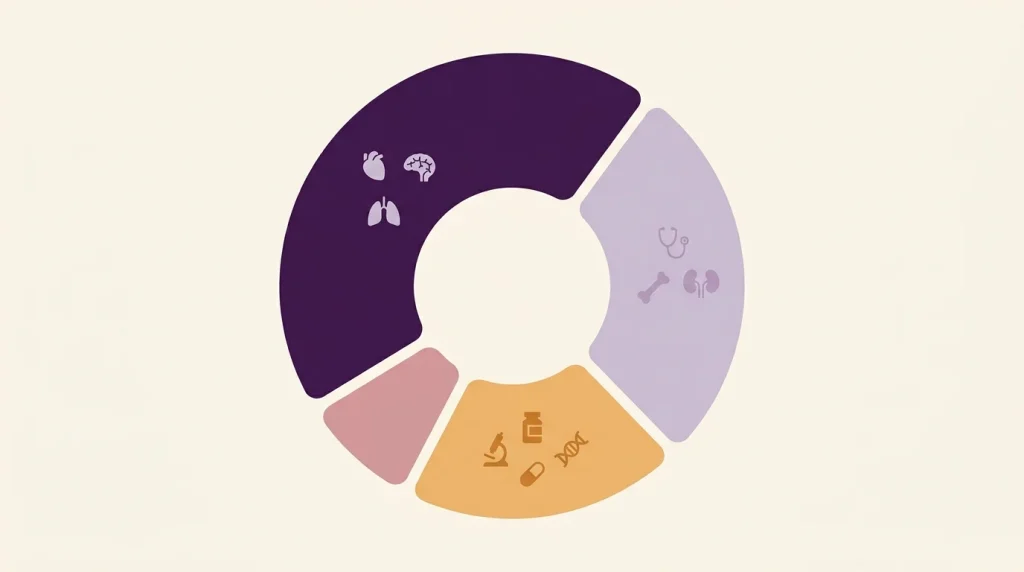
SLO3 (Resuscitation), SLO1 (Stable presentations) and SLO4 (Injured patients) carry 110 of the 180 marks between them — 61% of the paper. If you pass these three blocks comfortably and survive the rest, you pass.
- SLO3 – Resuscitation (40 Qs, 22%). Adult and paediatric resus, peri-arrest, sepsis bundles, anaphylaxis, major haemorrhage, hyperkalaemia, status epilepticus, RSI, drowning, electrocution, hypothermia, post-ROSC, and the resuscitative end-of-life decisions covered under SLO3 descriptors. Trauma resuscitation is explicitly inside SLO3 — it is not only in SLO4.
- SLO1 – Stable but complex (35 Qs, 19%). The broadest block. RCEM lists 25 syllabus areas under SLO1: allergy, cardiology, dermatology, ENT, elderly care, endocrinology, environmental, GI/hepatology, haematology, infectious diseases, maxillofacial/dental, mental health, MSK (non-traumatic), nephrology, neurology, O&G, oncological emergencies, ophthalmology, pain and sedation, palliative care, pharmacology/poisoning, respiratory, sexual health, surgical emergencies, urology and vascular. You will not finish it — prioritise the high-volume areas (cardiology, neurology, endocrinology, toxicology, infectious diseases, mental health).
- SLO4 – Injured patients (35 Qs, 19%). Major trauma management (ATLS-style), specific injury patterns, fractures and dislocations you must not miss, burns, head injury (NICE CG176), C-spine, paediatric trauma, pain and sedation. There is meaningful overlap with SLO3 — a trauma resus question can be tagged to either.
The practical implication of the SLO3 / SLO4 overlap: do not split your trauma revision artificially into “resus” and “not-resus”. Treat ATMIST, code-red activation, damage-control resuscitation, pelvic binders, traumatic cardiac arrest and TXA timing as one block. They appear on the paper regardless of which SLO they are catalogued under.
How much paediatrics is in the FRCEM SBA?
30 questions — 16.7% of the paper. SLO5 is the fourth-heaviest block and the one most candidates underestimate. RCEM’s published SLO5 descriptors are paediatric dermatology, ENT, GI/hepatology, infectious diseases, MSK (non-traumatic), neonatal emergencies, neurology, ophthalmology, respiratory, paediatric resus (BRUE, SUDIC protocol), safeguarding and psycho-social emergencies, and paediatric surgical emergencies. Paediatric trauma sits under SLO4. If your day-to-day work is adult-only, this is the block where targeted revision pays back fastest.
How much research, stats and QI is on the paper?
10 questions. SLO10 (research and data) and SLO11 (QI and patient safety) are blueprinted together as a single 10-question block. That is 5.6% of the paper — small in absolute terms, but high yield per revision hour because the syllabus is finite and predictable: diagnostic methodology, RCTs, systematic review structure, basic statistical techniques (sensitivity/specificity, likelihood ratios, NNT, confidence intervals, p-values), QI theories, measurement for improvement, run charts, common cause vs special cause variation.
This block replaced the standalone FRCEM Critical Appraisal and FRCEM QIP, which were withdrawn in 2021. The knowledge is now tested inside the SBA and OSCE rather than as separate components.
What does SLO7 / SLO12 (“challenging situations and management”) actually test?
10 questions, 5.6%. Two descriptor families:
- SLO7 – Complex or challenging situations. Medicolegal (capacity, consent, Mental Capacity Act, Mental Health Act sections relevant to ED), legislation, organ and tissue donation, information governance and confidentiality, safeguarding.
- SLO12 – Manage, administer and lead. Serious adverse event investigation tools — root cause analysis, 5 whys, fishbone (Ishikawa); complaint management.
Most candidates lose marks here because they revise it last. Read the RCEM safeguarding and consent guidance documents; they are short and the answers track them closely.
What about “lead the ED shift” – SLO8 / SLO12?
7 questions, 3.9% — the smallest block. Patient flow management, risk management, clinical governance. Pair this revision with the SLO7/SLO12 block above because the descriptors overlap and the question style is the same (governance vignette, single best decision).
How much of the paper is procedural skills (SLO6)?
13 questions, 7.2%. RCEM names six explicit SLO6 descriptors as exam-relevant: adult sedation, paediatric sedation, pericardiocentesis, non-invasive ventilation, escharotomy, and lumbar puncture. You will rarely have performed all of these. Read the RCEM Best Practice Guideline on procedural sedation in adults and the paediatric equivalent end-to-end — there are almost always 2–3 questions directly mappable to those documents.
Are the published weightings actually how the paper feels on the day?
Mostly yes — with two caveats consistently flagged on r/doctorsUK and by recent prize winners writing for RCEMLearning.
- Rarer presentations punch above their weight. Multiple successful candidates report that the SBA pulls disproportionately from the less common end of SLO1 and SLO3 — pituitary apoplexy, oncological emergencies, environmental emergencies, neonatal presentations, BRUE. “I am surprised by how many of the things I have never actually treated in practice” is a near-universal post-exam comment. Do not assume “high-yield” means “common in your ED.”
- Trauma, paediatrics and resus are the explicit “basics”. The most-upvoted IMG guidance on RCEMLearning is blunt: “Nail the basics: trauma, paediatrics, and resus. Master them, and you’re halfway there.” That maps cleanly to the blueprint — SLO3 + SLO4 + SLO5 = 105/180 = 58% of the paper.
How should I divide my revision hours across the blueprint?
Allocate hours roughly proportional to mark weight, then adjust for your starting point. A realistic split for a candidate with average baseline knowledge:
- SLO1 (Stable complex): 25% of hours. Largest syllabus surface area per mark — you cannot cover it lightly.
- SLO3 (Resus): 20% of hours. High-mark, but the content is more guideline-driven and finite (RCEM Best Practice Guidelines, ALS, APLS, ATMIST, major haemorrhage protocols).
- SLO4 (Trauma): 15% of hours. ATLS-style core plus NICE head injury and C-spine.
- SLO5 (PEM): 15% of hours. APLS, RCEM paediatric Best Practice Guidelines, safeguarding.
- SLO10/11 (Research + QI): 10% of hours — disproportionately worth it. Finite syllabus, predictable question style.
- SLO7/12 (Complex situations + management): 7% of hours. Read the RCEM consent, capacity and safeguarding pages end-to-end.
- SLO6 (Procedures): 5% of hours. Sedation guidelines, NIV indications, LP technique and contraindications.
- SLO8/12 (Lead the shift): 3% of hours. Combine with SLO7/12.
Has the blueprint changed under the 2025 FRCEM Exam Regulations?
No. The September 2024 FRCEM Exam Regulations (applicable to all 2025 exams) confirm the structure as 180 SBAs mapped to the RCEM Curriculum, delivered as two two-hour papers. The per-SLO question split is unchanged from the 2021/22 Information Pack; that pack remains the source of the detailed blueprint table. The RCEM curriculum itself was updated to v1.5 in August 2025 — the SLO numbering and assessment mapping are the same.
Plain facts you should know on exam day
- 180 questions, 2 papers × 90 questions, 2 hours per paper, 1 hour break.
- No negative marking. Always guess.
- Pass mark = modified Angoff cut score + 1 SEM. Varies by diet — RCEM do not publish a fixed percentage.
- Four attempts maximum (prior FRCEM Final SAQ attempts after August 2016 count towards this).
- Seven-year currency window from your first FRCEM pass to complete both components.
- Delivered through the Surpass testing network from January 2026 onwards, replacing Pearson VUE which was used in earlier diets.
- Results: published to your RCEM account around five weeks after the exam.
What does the blueprint not tell you?
Three things worth flagging:
- It does not give sub-topic weights within an SLO. SLO1 lists 25 specialty areas; RCEM does not state how many questions come from cardiology versus dermatology. Question patterns suggest cardiology, neurology, toxicology and infectious diseases carry more than their share, but RCEM has not published this.
- It does not flag question difficulty by SLO. SLO10/11 (research and QI) tends to be more recall-heavy and arguably easier per mark than SLO1 vignettes — worth keeping in mind when allocating effort.
- It does not promise the same mix in every diet. RCEM may remove questions after post-exam adjudication, so the working total marks for any given sitting can be lower than 180.
FAQ
How many questions are in the FRCEM SBA?
180 single-best-answer questions, delivered as two 90-question papers of two hours each, with a one-hour break between them. Each correct answer scores one mark; there is no negative marking, so you should answer every question even when you are guessing.
What is the highest-weighted SLO in the FRCEM SBA?
SLO3 (Resuscitate and stabilise patients in the ED) at 40 questions — 22.2% of the paper. SLO3 explicitly covers trauma resuscitation as well as medical resuscitation, palliative-care decisions in the resus room, and the decision to stop resuscitation.
How much paediatrics (SLO5) is in the FRCEM SBA?
30 questions — 16.7%. Paediatric trauma is tested under SLO4.
How many research and statistics questions are on the FRCEM SBA?
10 questions in total, grouped with QI as a combined SLO10/SLO11 block (5.6% of the paper).
Is there negative marking on the FRCEM SBA?
No. RCEM confirms one mark per correct answer and zero for an incorrect or unanswered question. Always answer every question, even with a power-guess in the last 30 seconds — unanswered counts as wrong.
What is the FRCEM SBA pass mark?
It is set per diet using the modified Angoff method plus one Standard Error of Measurement. RCEM do not publish a fixed percentage.
How is the SBA different from the old FRCEM Final SAQ?
The SAQ (short-answer questions, handwritten) was replaced by the SBA in August 2021. The SBA is fully multiple-choice with one best answer, computer-delivered, and blueprinted to the 2021 curriculum rather than the older one.
Where can I find the official FRCEM SBA blueprint?
In the RCEM document Regulations and Information Pack: FRCEM Final Examinations (Applicable from 1 August 2021), available from the RCEM FRCEM Exams page. The blueprint table is in the “Structure and Content” section.
Do I need to revise every SLO1 descriptor?
Realistically, no — the SLO1 syllabus has 25 specialty areas for 35 marks. Prioritise the highest-yield medical specialties (cardiology, neurology, endocrinology, toxicology, infectious diseases, mental health) and skim the rest.
Should I sit the SBA or the OSCE first?
Either order is permitted. Most candidates sit the SBA first because the underlying knowledge supports OSCE performance — then start OSCE-specific communication and EPIC-station drills about 6–8 weeks before the practical. Whichever you pass first, RCEM gives you seven calendar years to pass the other component before your original pass expires.
How long should I revise for the FRCEM SBA?
Common pattern is 4–6 months of structured revision alongside clinical work, with a heavier final push in the last 6 weeks. Luka Randic Medal winners writing for RCEMLearning describe “four topic areas covered in the first two months” as normal under full-time clinical commitments — budget time accordingly, and do not expect to cover every SLO1 descriptor before the exam.
Are guideline questions overrepresented?
Yes, in candidate experience. RCEM Best Practice Guidelines, NICE CG/NG documents, ALS, APLS and ATLS recur reliably. If you read the full guideline rather than a summary, you will recognise the question stem.
Facts last verified against the RCEM FRCEM Exams page and the September 2024 FRCEM Exam Regulations (V1, applicable to all 2025 exams). The published SBA blueprint table is unchanged from the 2021/22 Information Pack.
Next step: Cross-reference this blueprint with the top 10 high-yield FRCEM SBA topics, then sit weighted FRCEM SBA mock papers built around this blueprint at emfinalexams.com.
Ready to build your plan? EMF Premium gives you all 40,000+ questions, 20 mocks and 1,215 OSCE stations from £29/month — or a one-off 3- or 6-month pass.