

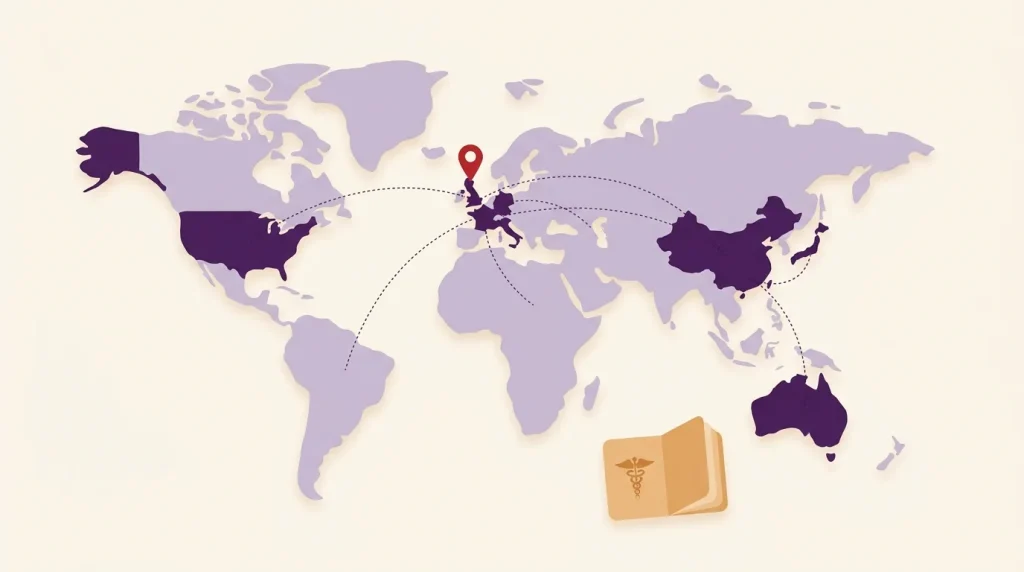
TL;DR. MRCEM (Membership of the Royal College of Emergency Medicine) is most useful in the UK and Republic of Ireland, where it is the formal middle-grade exam built into specialty training. It is widely accepted by employers and licensing bodies in the UAE, Saudi Arabia, Qatar, Oman, Singapore and Hong Kong as a recognised postgraduate qualification, usually as a route to a Specialist-grade (not Consultant) post. It is not a stand-alone licensing pass anywhere – you still need that country’s licensing exam, primary source verification (DataFlow / EPIC) and the relevant national medical council registration. Recognition rules change often. Always check the destination council’s own page before you commit.
flowchart TD
    M([MRCEM recognition]) --> UK[United Kingdom
Specialty training route]
    M --> IE[Ireland
EM training programme]
    M --> AE[United Arab Emirates
DOH/DHA/MOH licensing]
    M --> SG[Singapore
Selected pathways]
    M --> IN[India
State-by-state, NMC equivalence]
    M --> OT[Other countries
Check local regulator]
Facts last verified . Recognition tiers, scope-of-practice categories and exam-waiver rules change frequently – confirm directly with the medical council in the country you intend to work in before relying on this.
Quick country-by-country table
The table below is a peer-to-peer summary, not legal advice. “Recognised” means the regulator or employer accepts MRCEM as evidence of postgraduate training in emergency medicine – it does not mean MRCEM alone gets you a licence. “Tier” describes how MRCEM is typically used in practice.
For more on this, see our guide to IMG route to UK EM training via MRCEM.
| Country / region | Tier | What MRCEM gets you (typical) | Also need |
|---|---|---|---|
| United Kingdom | Core qualification | Entry to ST4 / progression in run-through EM training; a strong middle-grade EM CV; a core component of the Portfolio Pathway (CESR) for the GMC Specialist Register | GMC registration (via PLAB, MRCEM Primary+SBA route, or sponsorship); IELTS/OET; CREST form for non-training jobs |
| Republic of Ireland | Core qualification | Mandatory exit from Core Specialist Training (CSTEM) before progressing to Advanced Specialist Training (ASTEM); recognised by RCSI/IAEM | Medical Council of Ireland registration; IELTS/OET; supervised training post |
| UAE – Dubai (DHA) | Recognised | Eligible to apply as Specialist Emergency Medicine (subject to DHA evaluation and assessment exam); used in residency programmes that prepare trainees for Royal College memberships | DataFlow PSV; DHA assessment exam; Good Standing certificate; experience requirement (typically 2+ years post-qualification) |
| UAE – Abu Dhabi (DoH) | Recognised | Accepted toward Specialist tier on DoH evaluation | DataFlow PSV; DoH assessment; experience evidence |
| UAE – Northern Emirates (MOHAP) | Recognised | Accepted toward Specialist licensing in Sharjah, Ajman, RAK, UAQ, Fujairah | DataFlow PSV; MOHAP assessment exam (Prometric) |
| Saudi Arabia (SCFHS) | Recognised | Used in professional classification – typically classified as Specialist (with experience, progression toward Senior Specialist / Consultant) | DataFlow PSV; SCFHS Mumaris+ registration; classification interview/exam depending on category; UK-trained candidates may qualify for partial exam waivers |
| Qatar (DHP / MoPH) | Recognised | Counts toward Specialist registration with Qatar Council for Healthcare Practitioners (now Department of Healthcare Professions) | DataFlow PSV; QCHP/DHP Prometric assessment; experience evidence |
| Oman (OMSB / MoH) | Recognised | Accepted toward Specialist licensing; Muscat is an MRCEM exam centre, which signals the regulator is familiar with the qualification | DataFlow PSV; OMSB Prometric assessment |
| Bahrain (NHRA) | Recognised | Accepted toward Specialist registration | DataFlow PSV; NHRA assessment; Good Standing |
| Kuwait (MoH) | Recognised (case-by-case) | Accepted toward Specialist licensing on evaluation | DataFlow PSV; Kuwait MoH evaluation; KMLE where applicable |
| India (NMC) | Not equivalent to MD | MRCEM is not equivalent to an Indian MD/DNB in Emergency Medicine and does not automatically grant NMC specialist registration. See our deeper write-up: Is MRCEM recognised by MCI / NMC for India? | MD/DNB Emergency Medicine for Indian specialist practice; MRCEM remains valuable for export career and private hospital roles |
| Pakistan (PMDC / PMC) | Unverified (likely not formally recognised as a stand-alone PG qualification) | FCPS (CPSP) is the domestic EM specialty qualification. MRCEM is mostly used by Pakistani graduates as an export credential. Confirm directly with PMDC. | FCPS Emergency Medicine for domestic specialist practice |
| Sri Lanka (SLMC) | Unverified | Sri Lankan EM specialty training is delivered through the Postgraduate Institute of Medicine. MRCEM is used by some Sri Lankan EM doctors as an export credential. Confirm directly with SLMC. | MD Emergency Medicine (PGIM) for local specialist practice; SLMC registration |
| Singapore (SMC / SAB) | Historically recognised; check current rules | Pre-2020, MCEM (the old MRCEM) was accepted for progression to Senior Residency in Emergency Medicine. Singapore now runs the EM ABMS MCQ exit examination. MRCEM is recognised as a postgraduate EM qualification but is not the local exit exam. | SMC registration; SAB-accredited residency; local exit exam |
| Hong Kong (HKCEM / MCHK) | Historically recognised; check current rules | The local route is the Hong Kong College of Emergency Medicine (PEEM, IEEM, Exit). MRCEM Primary was historically accepted toward HKCEM Primary equivalence but check current HKCEM rules – acceptance was time-limited. | MCHK registration; HKCEM training programme; local exit exam |
| Australia / New Zealand (ACEM / AHPRA) | Not equivalent to FACEM | ACEM is the sole specialist EM college recognised by AHPRA and MCNZ. MRCEM is not equivalent to FACEM and does not grant specialist registration. Specialist IMGs apply via the ACEM SIMG pathway (Primary Source Verification through AMC, then comparability assessment). | FACEM (or successful SIMG comparability assessment); AHPRA registration |
| South Africa (HPCSA / CMSA) | Not equivalent to FCEM(SA) | South African specialist registration is via FCEM(SA) of the Colleges of Medicine of South Africa. MRCEM is not equivalent. | FCEM(SA); HPCSA registration |
| Malaysia (MMC) | Unverified | Local pathway is the Masters in Emergency Medicine and the National Specialist Register. MRCEM is recognised by some employers but not confirmed as a route to NSR. Confirm with MMC. | Master of Emergency Medicine; NSR registration |
What does “valid for work” actually mean?
This is the trap candidates fall into when they read recruiter blog posts. “MRCEM is recognised in X country” almost never means you can fly in and start work the next day. It means:
For more on this, see our guide to MRCEM eligibility and EM experience required.
- The country’s regulator will accept MRCEM on your application as evidence that you have postgraduate training in emergency medicine.
- You will still need to satisfy the local licensing process – usually an exam (Prometric or equivalent), primary source verification of your medical degree and MRCEM certificate (DataFlow for the Gulf, EPIC for South Africa, AMC for Australia, etc), a Good Standing certificate from every council you have ever been registered with, and a job offer from a licensed employer.
- The job title you get with MRCEM is almost always Specialist – one tier below Consultant. Promotion to Consultant usually requires additional years of experience and, in some countries, a higher exam (FRCEM, ArBEM, FCEM(SA), FACEM).
Does MRCEM let me work as a Consultant in the UK?
No – not on its own. MRCEM is a membership-level exam that sits at the equivalent of UK ST3 transition. To take a substantive NHS Consultant post in Emergency Medicine, your name must be on the GMC Specialist Register, which currently means either a Certificate of Completion of Training (CCT – the run-through training route) or the Portfolio Pathway (formerly CESR).
MRCEM is one of the central pieces of evidence the Portfolio Pathway will look for, alongside structured documentation of your overseas EM experience against the RCEM curriculum, but it is not sufficient on its own. With MRCEM and GMC registration, you can work in the UK as a Specialty Doctor, Specialist grade, Trust grade, or Clinical Fellow.
What about the Republic of Ireland?
Ireland uses the same MRCEM and FRCEM exams as the UK – the Royal College of Emergency Medicine is the awarding body for the National Emergency Medicine Training Programme delivered by the Irish Association for Emergency Medicine (IAEM) and the Royal College of Surgeons in Ireland (RCSI). Trainees must pass all elements of MRCEM by the end of Year 3 (CSTEM) to progress to Advanced Specialist Training (ASTEM). For IMGs, MRCEM plus Medical Council of Ireland registration is a strong combination for non-training and registrar-level posts. There is no separate “MRCEM Ireland” qualification.
Is MRCEM recognised in the UAE?
Yes – across all three UAE licensing authorities (DHA in Dubai, DoH in Abu Dhabi, and MOHAP for the Northern Emirates), MRCEM is accepted as a postgraduate qualification toward Specialist Emergency Medicine licensing. UAE residency programmes specifically prepare residents for Royal College memberships including MRCEM. In practice you will need DataFlow primary source verification, the relevant assessment exam (DHA/DoH/MOHAP – usually Prometric), a Good Standing certificate, and typically at least two years of post-qualification experience in EM before applying for a Specialist licence. None of the three UAE regulators publish a public “MRCEM = Specialist” tariff – the evaluation is per-applicant.
Is MRCEM recognised in Saudi Arabia?
Yes – the Saudi Commission for Health Specialties (SCFHS) accepts MRCEM during its Professional Classification process, which determines whether you are classified as Specialist, Senior Specialist or Consultant. UK-trained doctors and holders of recognised UK/Irish postgraduate qualifications often qualify for exam waivers depending on training duration and experience. You will still need DataFlow primary source verification, Mumaris+ registration and a sponsoring employer. Promotion to Consultant typically requires at least three years of post-qualification experience for Group 1 qualifications and five years for Group 2. SCFHS does not publish a per-qualification tariff – confirm your specific classification with SCFHS before relying on any recruiter promise.
Does MRCEM let me work in Qatar, Oman, Bahrain or Kuwait?
Yes, in all four – but each one has its own licensing exam and process. Passing one Gulf exam does not license you in any other Gulf country.
- Qatar: Department of Healthcare Professions (DHP, formerly QCHP) – DataFlow PSV plus a Prometric assessment specific to your specialty and grade.
- Oman: Oman Medical Specialty Board (OMSB) – DataFlow plus Prometric. Muscat is an MRCEM exam centre, which makes the qualification well-understood locally.
- Bahrain: National Health Regulatory Authority (NHRA) – DataFlow plus NHRA assessment.
- Kuwait: Kuwait Ministry of Health – more variable case-by-case evaluation.
Does MRCEM let me work in Singapore?
Partly. The Singapore Specialists Accreditation Board (SAB) and Singapore Medical Council (SMC) maintain a structured residency programme with a local exit examination (currently the Emergency Medicine ABMS MCQ). Historically, MCEM (the pre-2020 MRCEM) was accepted for progression to Senior Residency in Emergency Medicine with the Programme Director’s certification, but the rules have tightened since 2020 – MRCEM is recognised as a postgraduate EM qualification but is no longer a direct substitute for the local exit exam. For overseas EM specialists, the route is SMC conditional registration plus SAB comparability assessment – MRCEM strengthens that application but does not replace it. Confirm current SMC/SAB rules before applying.
Does MRCEM let me work in Hong Kong?
Not directly. The specialist pathway is run by the Hong Kong College of Emergency Medicine (HKCEM) with its own three-stage exam programme: Primary (PEEM), Intermediate (IEEM) and Exit. Historically MRCEM Primary was accepted as equivalent to HKCEM Primary under certain transitional rules, but acceptance has been time-limited and the current rules sit with HKCEM. MRCEM is useful for clinical fellow and middle-grade locum posts in Hong Kong but is not a substitute for HKCEM Fellowship for specialist registration. Check HKCEM directly.
What about India – does MRCEM count there?
This is the most-asked question by Indian MBBS graduates and the answer is nuanced enough to deserve its own article: see Is MRCEM recognised by MCI / NMC for India? Short version: MRCEM is not equivalent to an Indian MD or DNB in Emergency Medicine for the purposes of National Medical Commission specialist registration. MD/DNB Emergency Medicine (3-year NMC-recognised programmes) are the domestic route to Indian specialist status. MRCEM is widely used by Indian EM doctors as an export credential – it is the cheapest, fastest way to demonstrate UK-recognised EM training and unlocks Gulf, UK and Irish job markets. Many large Indian private hospital chains value MRCEM holders for their EM departments.
What about Pakistan, Sri Lanka and Bangladesh?
For all three, the domestic specialist pathway is the local Fellowship (FCPS for Pakistan via CPSP, MD via the Postgraduate Institute of Medicine for Sri Lanka, FCPS for Bangladesh via BCPS). MRCEM is overwhelmingly used by graduates from these countries as an export credential to access UK, Irish and Gulf jobs – not as a route to domestic specialist registration. We have not verified whether PMDC, SLMC or BMDC currently list MRCEM as a recognised foreign postgraduate qualification on their respective registers. If you need PMDC/SLMC/BMDC equivalence specifically, contact the council directly.
Will MRCEM work in Australia or New Zealand?
Not as a specialist qualification. ACEM (Australasian College for Emergency Medicine) is the sole body recognised by the Australian Medical Board (via AHPRA) and the Medical Council of New Zealand for EM specialist registration. The local Fellowship is FACEM. MRCEM is not equivalent to FACEM. Overseas-trained EM specialists apply through the ACEM SIMG (Specialist International Medical Graduate) comparability pathway – primary source verification through the AMC, then case-by-case comparability assessment by ACEM. MRCEM holders typically need substantial additional experience plus successful SIMG assessment to be deemed comparable to FACEM. MRCEM is helpful supporting evidence but not a shortcut.
What about South Africa?
South Africa runs its own specialist Fellowship – FCEM(SA) – through the Colleges of Medicine of South Africa. HPCSA specialist registration requires FCEM(SA) or an HPCSA-recognised equivalent. MRCEM is not currently listed as equivalent. South African EM doctors do sit MRCEM as a portable credential, but it does not grant HPCSA specialist registration.
What does the recognition actually cost you?
Across every country above, the practical recognition path involves three cost buckets that catch candidates out:
- Primary source verification – DataFlow (Gulf, ~USD 200-300 plus document fees), EPIC/ECFMG (USA/South Africa), AMC (Australia). Slow – allow 6-12 weeks.
- The local exam – Prometric MCQs cost USD 150-400 per attempt; ACEM SIMG fees run into thousands of AUD.
- Good Standing certificates from every council you have ever been registered with – small fees per certificate but they expire (usually 3 months) and councils are slow.
How do I check current recognition before I commit?
Recognition rules change quickly – the Gulf councils in particular update their classification matrices yearly. Do this before paying for any exam or training:
- Find the destination country’s medical council website (not a recruiter blog).
- Look for a page titled “recognised qualifications”, “professional classification requirements” or “specialty equivalence”.
- If MRCEM is not explicitly listed, email the council with your specific qualification, year of award and intended grade. Get the answer in writing.
- Cross-check with a UK recruiter who places EM doctors in your target country – they will know the current employer-side reality, which sometimes differs from the council’s published list.
- Talk to at least one MRCEM-holding doctor currently working in that country (the IMG Connect, BDI Resourcing and country-specific Telegram/Facebook groups are good places to find them).
Bottom line
MRCEM is one of the most internationally portable EM postgraduate qualifications in 2026, but “portable” is not the same as “licence to work”. Treat it as a strong piece of evidence on your CV that opens doors in the UK, Ireland, all six GCC countries, Singapore and Hong Kong – and that is rejected as a substitute qualification in Australia, New Zealand and South Africa, while sitting in a separate category from domestic MD/DNB in India, Pakistan and Sri Lanka. Every individual job still needs the local licensing process. Always confirm with the destination council before you commit.
Facts last verified .
Ready to build your plan? EMF Premium gives you all 40,000+ questions, 20 mocks and 1,215 OSCE stations from £29/month — or a one-off 3- or 6-month pass.