TL;DR. Two techniques carry the most evidence in cognitive science for long-term retention: active recall (forcing yourself to retrieve an answer from memory) and spaced repetition (reviewing material at increasing intervals so you revisit each fact just as you are about to forget it). For FRCEM SBA: do question-based revision daily instead of re-reading; turn every SBA you get wrong into a one-line Anki card (stem prompt on the front, the discriminating fact on the back); review those cards using an algorithm (Anki default, or AnKing-style settings) so the same card comes back in 1 day, then 3, then 7, then 21. That is the whole game. Everything below is how to do it without burning out, with sources you can check. For broader revision context, see our guide to building an Anki deck for MRCEM Primary. See also our guide to how many months you really need to revise for FRCEM SBA.
If you have ever finished a six-hour reading session on toxicology, felt vaguely competent, and then bombed three SBAs on paracetamol the next morning – you are not lazy and you are not stupid. You are using a study technique (passive re-reading) that the cognitive science literature has shown does not work for retention. The Royal College of Emergency Medicine SBA is a recall-and-discrimination exam. Your revision has to mirror that.
This guide is for FRCEM SBA candidates (Primary and Intermediate) who want a method that holds up to night shifts, leave that gets cancelled, and an exam date that keeps getting closer. The evidence base sits behind two techniques. We will cover what they are, why they work, and exactly how to apply them to FRCEM SBA prep.
Why does passive reading fail for FRCEM SBA?
When you re-read a chapter, you experience a feeling of fluency – the words look familiar, so your brain reports “I know this”. Roediger and Karpicke’s 2006 study showed this is an illusion. Students who repeatedly studied prose passages felt more confident than students who took practice tests, but on a delayed retention test one week later, the testing group recalled substantially more. Confidence and retention were dissociated (Roediger & Karpicke, Psychological Science 2006).
The SBA punishes this exact failure mode. The stem gives you a 65-year-old with chest pain, a borderline troponin, and a slightly off ECG. Four of the five answer options are plausible. You do not need to recognise the topic – you already know the topic is ACS. You need to retrieve the discriminator under time pressure. Recognition study leaves you with recognition memory. SBAs demand retrieval memory. They are not the same thing.
What is active recall, and why does it work?
Active recall (also called retrieval practice or the testing effect) is the act of pulling information out of memory without looking at the source. Every time you do this successfully, the memory trace is strengthened more than it would be by re-reading the same material. This has been replicated across hundreds of studies in the last twenty years and is one of the most robust findings in learning science (Sumeracki, The Learning Scientists 2022).
The mechanism matters because it tells you what counts as “active”. Reading a textbook with a highlighter is not active recall. Watching a lecture is not active recall. Even copying notes by hand is not, really – your eyes are on the source. The minimum bar is: cover the source, ask yourself a question, produce an answer from memory, then check. That single loop is what builds durable memory.
What is spaced repetition, and why does it work?
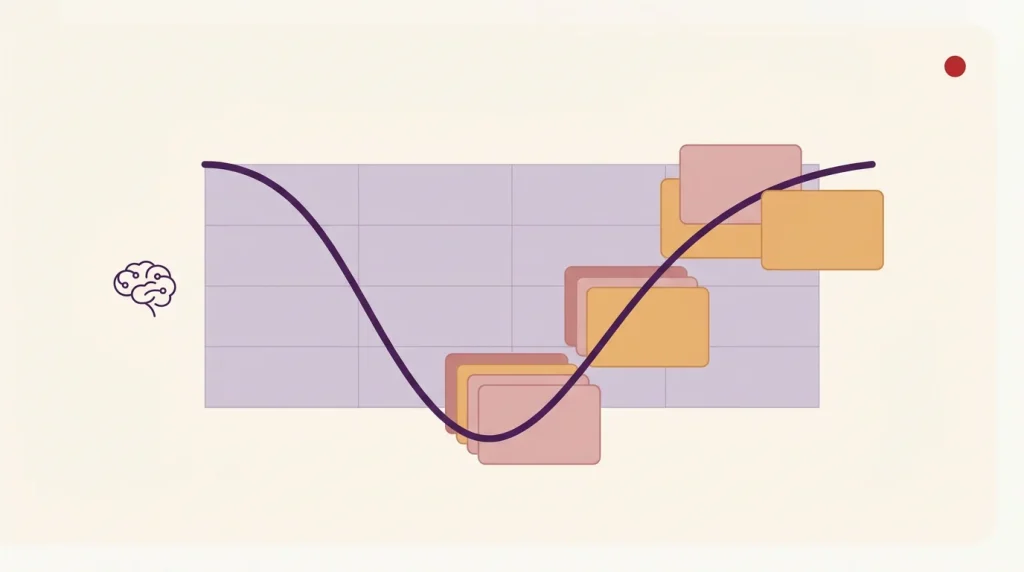
Spaced repetition exploits the forgetting curve – the fact that newly learned information decays unless you revisit it. If you revisit a fact just as you are about to forget it, the memory is strengthened and the next forgetting interval gets longer. Do this five or six times and a fact can stick for years.
The evidence for spacing over massed practice is overwhelming. In one Educational Psychology Review study, engineering students whose precalculus quizzes were spaced (one question per concept per week) outperformed students whose quizzes were massed (all questions for one concept in the same week) on the cumulative final – and the benefit carried into the next semester’s calculus course (Hopkins et al., reviewed at The Learning Scientists 2022). For SBA candidates this is the difference between knowing the asthma BTS thresholds in week three and still knowing them on exam day in month six.
How do active recall and spaced repetition combine?
On their own each technique helps. Used together, they produce the largest effect. Spaced repetition tells you when to revisit a fact. Active recall is what you do when you revisit it. The most efficient implementation is a spaced-repetition flashcard app (Anki is the default in the medical community; RemNote and Memrise work similarly) that schedules a small batch of cards for you each morning. You see a question, type or think the answer, grade your performance, and the algorithm pushes the card forward by 1, 3, 7, 21, 60 days depending on how well you did.
That is the whole loop. Twenty to forty minutes a day of this beats a four-hour weekend re-read session for SBA recall.
How do I turn FRCEM SBA content into Anki cards?
This is where most candidates get stuck. The instinct is to copy whole textbook paragraphs onto cards. Do not do that. The card has to test one fact at a time and force a specific retrieval. Here is how to convert common FRCEM content types:
| Source content | Bad card | Good card (front / back) |
|---|---|---|
| Failed SBA on paracetamol overdose | “Tell me everything about paracetamol overdose” | Front: Threshold for NAC in single acute paracetamol overdose, time-known Back: Plot 4-hour level on the 100 mg/L treatment line (UK MHRA guidance, post-2012) |
| Asthma BTS/SIGN guideline | “BTS asthma severity criteria” | Front: PEF threshold (% predicted) defining acute severe asthma in adults Back: 33-50% predicted/best |
| ECG topic | “ECG findings in hyperkalaemia” | Front: Earliest ECG change in hyperkalaemia Back: Tall, tented (peaked) T waves |
| Pharmacology | “Beta-blocker overdose management” | Front: First-line antidote for haemodynamically unstable beta-blocker overdose Back: IV glucagon (50-150 mcg/kg bolus, then infusion); high-dose insulin/euglycaemia second-line |
| Paediatric resus | “Paeds APLS doses” | Front: Defibrillation dose for paediatric VF/pulseless VT (J/kg) Back: 4 J/kg |
Two rules: one fact per card, and the front must phrase the question the way an SBA stem would phrase it. If your card asks “what is the management of X” your brain will answer with a paragraph. If it asks “first IV drug in X, adult dose included”, your brain produces a specific testable answer.
How many cards a day should I be doing?
For FRCEM SBA, sustainable volumes look like this:
| Phase | New cards/day | Total reviews/day | Time |
|---|---|---|---|
| First month (building the deck) | 15-25 | 50-100 | 20-30 min |
| Mid-prep (3-4 months out) | 20-30 | 150-250 | 30-45 min |
| Final 6 weeks | 5-10 | 250-400 | 45-60 min |
| Final 2 weeks | 0 | 300-500 (review only) | 60-90 min |
Two things go wrong. The first is adding too many new cards in week one, getting a 600-card review pile by week three, and abandoning the system. The second is adding new cards in the last fortnight – those cards will not have time to space-repeat before the exam and just steal time. Stop adding new cards 10-14 days out.
What is the simplest weekly study routine using these techniques?
You do not need a complicated plan. Anchor your week around three activities:
- Daily Anki review (every day, no exceptions, including post-night). Do reviews first – even 50 cards counts. If you skip a day, the pile grows.
- Daily question bank (qbank) block, 20-40 SBAs in timed mode. This is active recall in exam format. Tag every wrong answer.
- Weekly card-making session, 60-90 minutes. Turn every tagged wrong answer from that week into one Anki card. Read the explanation, identify the single fact that would have got you the answer, write that fact as a card. Then close the qbank.
That is the whole routine. Reading textbooks is for filling specific knowledge gaps the qbank uncovers – not for systematic chapter-by-chapter coverage. RCEM Learning, the Oxford Handbook of Emergency Medicine, and the EMRAP material are reference texts here, not the primary study activity.
How do I use spaced repetition for high-yield UK-specific topics?
Some FRCEM content updates faster than your textbooks – 2025 ALS/APLS changes, current NICE sepsis thresholds, RCEM safety alerts. For these, the value of spaced repetition is keeping the current number in your head, not the version you learned two years ago. Practical tactic:
- Tag cards by source and date. When a guideline updates (e.g. Resuscitation Council UK 2025 changes to refractory VF), suspend the old cards and add new ones rather than editing in place.
- Keep one deck called “UK-specific numbers” – paracetamol nomogram line, RCEM 4-hour standard, sepsis lactate threshold for critical care referral, ED CT head rules, NEWS2 trigger scores. These are the cards you want to review most aggressively in the final fortnight.
- If a fact has a NICE / RCEM / JRCALC source, put the source on the back of the card. Saves you re-googling when you are not sure why a card said something.
What do FRCEM candidates on UK forums actually say works?
The pattern that comes up repeatedly on r/doctorsUK and r/emergencymedicine when candidates share what worked: question banks done in timed exam mode from day one, an Anki deck built from their own mistakes rather than someone else’s pre-made deck, and consistency over intensity. The candidates who post about passing comfortably tend to describe 30-60 minutes a day for four to six months. The candidates who post about failing tend to describe heroic weekend sessions and no daily routine.
A second pattern: most successful candidates do not use Anki for everything. They use it for the discrete facts (drug doses, ECG criteria, classification systems, thresholds), and they use timed SBA blocks for the integration skills (recognising the clinical pattern, weighing options under time pressure). Trying to make Anki cards out of clinical reasoning is what burns people out. Use the right tool for the right job.
How do I keep this up on a busy ED rota?
The single most important rule: do reviews before you do anything else with your phone. Anki on your phone, first thing, with coffee. Twenty minutes. Then the day is yours and the streak is preserved. Cards do not care that you were on a long day yesterday; they care that you press the button today.
- Post-night reviews: do half your reviews (the older, easier ones) before sleep, and the rest when you wake up. Splitting it stops the day-after pile-up.
- Annual leave: pre-suspend new cards for the holiday and keep reviews going at half pace. Two weeks of zero reviews creates a 1,000-card pile that will take a fortnight to dig out of.
- Audit your deck monthly: leeches (cards you keep failing) get deleted or rewritten, not ground through. A card you have failed eight times is a badly written card, not a memory problem.
How long before the exam should I start?
Four to six months of consistent daily work using active recall plus spaced repetition will get most candidates over the line for FRCEM SBA at either Primary or Intermediate level. Three months is doable if you can hit 45-60 minutes a day. Less than eight weeks and you are in cramming territory – which is when passive techniques start to creep back in because the volume feels overwhelming. If you have less than eight weeks, drop the new-card additions, do reviews of any existing deck, and pour the rest of your time into timed qbank under exam conditions. Cramming with active recall (qbanks) still beats cramming with re-reading.
FAQ
Is Anki the only spaced repetition app worth using for FRCEM?
No – RemNote, Memrise, and SuperMemo all use spaced repetition algorithms. Anki is the default because it is free, the medical community uses it, and the shared decks ecosystem is mature. For FRCEM specifically there is no de-facto community deck of the quality of (for example) AnKing for USMLE, so most UK candidates build their own deck. That is fine – building the cards is itself a form of active recall.
Should I use a pre-made FRCEM Anki deck?
Probably not as your only deck. Pre-made decks suffer from two issues: cards you do not understand the source of, and cards that test someone else’s idea of high-yield. The deck you build from your own qbank mistakes is automatically targeted at your gaps. Use a pre-made deck as supplementary if at all.
How many qbank questions do I need to do for FRCEM SBA?
Most candidates who pass comfortably report doing 2,000-4,000 SBAs across their preparation, often using two qbanks (e.g. one UK-focused, one with a wider question pool). The number matters less than the post-question process: every wrong question is turned into one card and the explanation is read in full.
What if I get the same Anki card wrong every time?
That card is a “leech” and it is almost always badly written. Either you have crammed too much onto one card, or the question is ambiguous, or it tests something you do not actually understand at concept level. Delete it and either rewrite it as two simpler cards or go back to the source material and learn the concept first.
Is it OK to do Anki on the train, between cases, in the loo?
Yes. Spaced repetition tolerates fragmented sessions well. Three 10-minute sessions across the day works as well as one 30-minute block.
Does writing my own notes still have a place?
Yes, but only as a precursor to active recall – not as a substitute for it. Writing a one-page summary of a topic in your own words is a moderate-strength learning activity. Re-reading that summary later is weak. Turning the summary into cards is what makes the time pay off.
Should I use cloze deletions or question/answer cards?
For discrete facts (drug doses, scores, thresholds) cloze deletions work well and are quick to make – hide the number, show the rest. For clinical patterns and rules of thumb, question/answer cards force a cleaner retrieval. Most FRCEM decks end up as a mix.
I am studying with a partner. Does active recall still work?
It works better. Teaching a colleague forces you to retrieve and articulate at the same time. Take turns posing SBA-style questions to each other from the qbank, or just from memory. The Protege Effect (you learn more by teaching) is real and stacks on top of retrieval practice.
What about mind maps and diagrams?
Useful for the initial encoding of a complex topic (e.g. understanding the coagulation cascade) – making the diagram is mildly active. Re-looking at the diagram later is passive. Convert the diagram into recall prompts (“name the three intrinsic pathway factors”) and you get the benefit.
Do I need to know the cognitive science to apply it?
No. You need to do the thing. The science is included here so you can stop second-guessing the method when re-reading feels more productive (it is not). Trust the process and check the sources if you doubt it.
What is the single highest-leverage change I can make this week?
Stop re-reading textbook chapters. Replace that time, hour for hour, with timed qbank SBAs followed by one-card-per-wrong-answer in Anki. Do this for two weeks and your mock scores will move. For broader revision context, see our guide to why skipping mock exams is the biggest FRCEM SBA mistake.
Next step: Browse the FRCEM SBA prep courses, qbanks and feedback resources at emfinalexams.com.
Facts last verified .
Sources:
- Roediger HL & Karpicke JD. Test-enhanced learning: taking memory tests improves long-term retention. Psychological Science 2006;17(3):249-55. PubMed
- Sumeracki M. Spaced retrieval practice benefits long-term learning and transfer. The Learning Scientists, August 2022. Source
- StudyMedical. Active recall and spaced repetition: FRCEM SBA study hacks. Source
Ready to build your plan? EMF Premium gives you all 40,000+ questions, 20 mocks and 1,215 OSCE stations from £29/month — or a one-off 3- or 6-month pass.