
TL;DR: RCEM does not publish per-diet FRCEM SBA cohort averages openly. The only place the cohort average lands is your personal feedback letter, released about five to six weeks after each diet. Anecdotal and sample-letter data put the typical FRCEM SBA cohort average somewhere in the high-50s to low-60s out of 180 (roughly 55-62%), against a pass mark that has hovered in the 60-65% band (Angoff + 1 SEM, set per diet). The 2024 RCEM headline pass rate for FRCEM SBA was 51.1% (2023: 47.0%). If your mock is 62%, you are at or slightly above the median candidate but still inside the danger zone for the pass mark.
You ran a full timed 180-question mock, scored 62%, and now you want to know whether that puts you ahead of the pack or in the bottom half. This page answers that exact question for the FRCEM SBA. We will be honest about what RCEM actually publishes, what we can infer from the public pass-rate reports and the sample feedback letter, and what real candidates report in cohort comparison threads.
Where does RCEM actually publish the FRCEM SBA cohort average?
It does not, in any open document. The cohort average is treated as private candidate feedback.
RCEM’s Results, Feedback and Awarding page is explicit about this. Within one week of results release, every candidate receives a feedback letter that contains four numbers:
- Your score (marks out of 180)
- The exam pass mark for that diet
- The cohort average for that diet
- A breakdown by Specialty Learning Outcome (SLO)
That letter is the only RCEM artefact where the cohort average appears. The annual exam pass rate reports publish pass rates (and EDI breakdowns), but not the mean score per diet.
Practical implication: the only legitimate sources for cohort-average data are (a) screenshots of feedback letters posted on Reddit and Telegram cohort threads, and (b) the redacted sample letter RCEM publishes as a template.
What number does RCEM’s sample feedback letter actually show?
The current FRCEM SBA sample feedback letter (v1) uses a real-format dummy candidate. The headline numbers in that template are:
- Candidate’s overall score: 122/177 (68.93%)
- Cohort average overall: 103/177 (58.19%)
You will note the denominator there is not 180 — a small number of items get removed each diet during post-exam psychometric review, so the working total varies slightly. The 58.2% cohort average in that template is consistent with what candidates report on Reddit and in private cohort spreadsheets across recent diets.
Two caveats. The sample letter is illustrative — RCEM has not labelled it as a specific diet. And the SLO-level cohort averages on the same letter (range 44.95% on SLO 10 Research to 77.15% on SLO 7 Complex/challenging) tell you the shape of the distribution more usefully than the headline.
How does the cohort average compare to the pass mark?
This is the question that matters. The FRCEM SBA pass mark is not fixed — it is set per diet using the Angoff method plus one Standard Error of Measurement (SEM). That means easier papers get higher pass marks and harder papers get lower ones, and the cohort average tracks paper difficulty too.
Plain-text key facts on the gap:
- Pass mark typical range, recent FRCEM SBA diets: roughly 108-125 marks out of 180 (~60-69%)
- Cohort average typical range, recent FRCEM SBA diets: roughly 100-112 marks out of 180 (~55-62%)
- Typical gap, average-to-pass-mark: 5-12 marks above the cohort mean
- Implication: the median candidate fails on most diets. The pass mark is set above where the average candidate scores.
That last point is the most misunderstood thing about this exam. It is not norm-referenced; it is criterion-referenced with a moving cut score. Beating the cohort average is necessary but not sufficient.
What do the public RCEM pass rates tell us about the cohort?
This is the data RCEM does publish openly, and it lets you infer cohort shape indirectly.
FRCEM SBA pass rates by year
| Year | Candidates | Passes | Pass rate |
|---|---|---|---|
| 2024 | 1,093 | 558 | 51.1% |
| 2023 | 1,102 | 518 | 47.0% |
Source: RCEM Exam Pass Rate Report 2024 and 2023 report. RCEM’s own statistical test classifies the 2024 vs 2023 change as not significant.
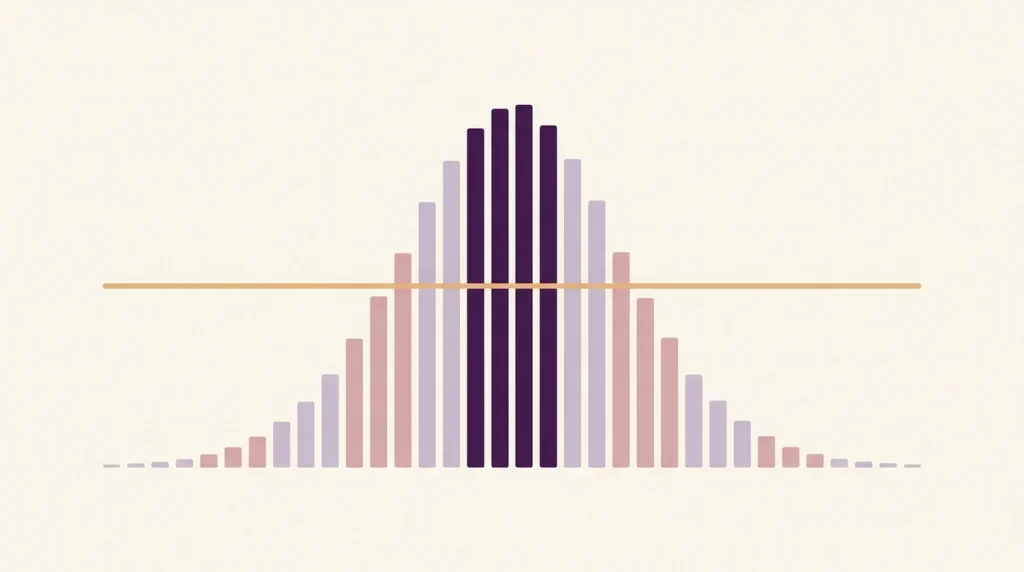
A pass rate around 50% combined with an Angoff cut score sitting just above the cohort mean implies a roughly symmetrical distribution centred just below the pass mark. In other words, on a normal diet a 62% mock score puts you near the centre of the cohort, not in front of it.
Pass rates by trainee status (FRCEM SBA + all RCEM diets combined, 2024)
| Group | Pass rate |
|---|---|
| UK trainees | 79.6% |
| UK non-trainees | 57.2% |
| ROI trainees | 48.5% |
| International candidates | 46.0% |
| First-attempt candidates (any diet) | 66.6% |
| Second-attempt candidates | 31.4% |
| Native English speakers | 64.4% |
| English not first language | 47.5% |
These are headline RCEM numbers across all exams, not FRCEM SBA only — but the directional message is the same in the per-diet breakdowns: UK trainees outperform IMGs by 25-30 percentage points, and second-attempt pass rates collapse to roughly half of first-attempt rates.
What does the SLO breakdown of the cohort average look like?
From the RCEM sample feedback letter, here is the published SLO-level cohort performance — the most granular public data point we have on the FRCEM SBA cohort:
| SLO | Questions | Cohort average |
|---|---|---|
| SLO 1 — Complex stable patient | 32 | 63.7% |
| SLO 3 — Resuscitate | 37 | 56.3% |
| SLO 4 — Injured patient | 35 | 57.1% |
| SLO 5 — Paediatric EM | 28 | 55.9% |
| SLO 6 — Procedural skills | 20 | 48.5% |
| SLO 7 — Complex/challenging situations | 11 | 77.2% |
| SLO 8 — EPIC | 4 | 53.9% |
| SLO 10 — Research | 10 | 45.0% |
| Overall | 177 | 58.2% |
Two things to extract from this. First, Research (SLO 10) is the weakest area for the cohort — under 50% on average, which is consistent with the pattern that critical appraisal/QI is the most under-prepared section. Second, SLO 7 (Complex/challenging) is the cohort’s strongest area, which makes sense given the small question count and overlap with shop-floor SAU/ED practice.
How accurate is your mock score as a cohort benchmark?
It depends entirely on which question bank you used. Three points to be honest about:
- Question banks calibrate differently to the real exam. Bromley, MasterFRCEM, FRCEM Tutor, Pastest and MDster have meaningfully different difficulty curves. A 62% on one bank’s timed mock is not a 62% on another.
- Retention bias inflates mock scores. If you have done 60-70% of the question bank already, your timed mock is partly a memory test, not a true unseen-paper simulation. Saved mocks done as the final pass are the best proxy.
- Timing is half the exam. If you scored 62% in 4 hours, that beats 62% scored in 5 hours. The exam gives you 80 seconds per question on average.
The closest unbiased estimate is: take your timed unseen mock score, subtract 5-8% for the gap between question bank difficulty and the real exam (the real exam tends to feel harder), and that is roughly where you would land in the cohort on the day.
What do candidates actually report in cohort comparison threads?
Cross-checked against r/doctorsUK threads and Telegram cohort spreadsheets from 2024-25 diets, the consistent reports are:
- Most candidates who passed cleared the pass mark by 3-10 marks (i.e. scored 64-72%).
- Candidates scoring 65-70% on full-length timed mocks in the final fortnight typically reported a pass.
- Candidates scoring 55-60% on timed mocks two weeks before the diet typically reported a fail.
- The MRCEM SBA September 2024 diet had a pass mark of 117/179 (65.4%) — the FRCEM SBA pass mark tends to sit in a similar range diet-to-diet.
- Frequent complaint: the real paper feels “15% harder” than the major question banks, particularly on management/QI and research stems.
Anecdotal but consistent: candidates who treat 65% on a final timed mock as their target tend to land safely above the cut score; candidates who plateau at 60% are statistically more likely to be in the failing half of the distribution.
If the cohort average is around 58%, why is the pass mark higher?
Two reasons, both deliberate.
First, the Angoff standard-setting process asks expert examiners to estimate the probability that a borderline-but-just-competent candidate would get each question right. The pass mark is the sum of those probabilities. It is set against a notional minimally competent candidate, not the average candidate sitting the diet.
Second, RCEM adds one Standard Error of Measurement (SEM) on top of the Angoff cut score. This protects against false-positive passes — it builds in a buffer so that a candidate who is genuinely at the borderline does not pass by random luck.
The combined effect: the pass mark sits a few marks above where the cohort average lands on a typical diet. That is the system working as designed, not a bias against candidates.
What does this mean for a candidate with a 62% mock?
Three concrete reads, depending on context:
- If 62% is a full-length, timed, unseen mock done in the final two weeks: you are at or slightly above the cohort average but likely below the pass mark. You are in the “could pass with another fortnight” band. Aim to push the timed mock to 68%+.
- If 62% includes questions you have seen before: discount by 8-10% for retention bias. You are probably scoring ~52% on a true unseen paper, which is below the cohort average and well below the pass mark.
- If 62% was on a bank that runs slightly easier than the real exam (Bromley, MDster): assume the real paper sits 5-8% harder. Your effective score is closer to 55%. Defer the sitting if you can.
None of these reads is intended to scare you off the sitting. They are intended to make the booking decision data-informed.
What about FRCEM SBA pass mark history — is there a pattern?
RCEM does not publish a per-diet pass mark table for FRCEM SBA. What we can say from the published documents and feedback letters circulating in candidate communities:
- The pass mark moves with paper difficulty — there is no fixed threshold.
- Across recent diets, the FRCEM SBA pass mark has been reported in the 108-125 range out of 180 (~60-69%).
- The standard error of measurement adjustment means a 1-2 mark difference between sitting and the borderline candidate disappears.
- RCEM publishes the pass mark for your diet in your feedback letter — there is no pre-diet announcement.
What should you actually do with this information?
Three actions:
- Target 70% on full-length timed mocks in the final fortnight, not 62%. That gives you a buffer against the real-paper difficulty step-up and the SEM-padded pass mark.
- Audit your weak SLOs against the cohort average breakdown. If you are below 50% on SLO 10 Research or SLO 6 Procedural Skills, those are high-yield revision targets because the whole cohort is weak there.
- Sit a true unseen mock at least once. Reserve 180 fresh questions you have not touched, do them in two two-hour blocks with a one-hour break, mark cold. That number is the only reliable cohort benchmark you have access to.
Ready to put this into structured revision? Start with the FRCEM-specific resources at emfinalexams.com — they are calibrated to the current 2021 curriculum blueprint and the SLO weightings RCEM publishes.
Frequently asked questions
Does RCEM publish FRCEM SBA cohort averages publicly?
No. The cohort average is released only in each candidate’s personal feedback letter. The annual pass rate reports show pass rates and demographic breakdowns but not mean scores per diet.
What is the typical FRCEM SBA cohort average?
Based on the RCEM sample feedback letter and consistent candidate reports, the cohort average typically sits between 55% and 62% (roughly 100-112 marks out of 180). The published sample letter shows a cohort overall average of 58.2%.
What is the FRCEM SBA pass rate in 2024?
51.1% (558 passes out of 1,093 candidates), per the RCEM Exam Pass Rate Report 2024. The 2023 pass rate was 47.0%.
What is the FRCEM SBA pass mark?
It is set per diet using the Angoff method plus one Standard Error of Measurement, so it varies. Recent reported pass marks have fallen in the 108-125/180 range (~60-69%). Your specific diet pass mark appears in your feedback letter.
If I score 62% on a mock, will I pass FRCEM SBA?
Probably not on a typical diet. 62% would put you near the cohort average but below the pass mark, which usually sits 5-12 marks above the mean. Aim for 68-70% on a full-length timed unseen mock as your safe target.
Is the FRCEM SBA cohort average rising or falling?
No published trend data exists at diet level. The overall pass rate has been broadly stable (47-51%) across 2023-24, suggesting the relationship between the cohort mean and the pass mark is also stable diet-to-diet.
Why is the pass mark higher than the cohort average?
The pass mark is criterion-referenced — set against a minimally competent borderline candidate using the Angoff method, then adjusted up by one SEM to protect against false-positive passes. It is not set against the actual cohort mean.
Do UK trainees score higher on FRCEM SBA than IMGs?
The RCEM 2024 pass rate report shows a substantial gap across all RCEM exams combined: UK trainees 79.6%, international candidates 46.0%. Per-diet score data is not published but the pattern is consistent across diets.
How is the FRCEM SBA cohort average calculated?
It is the simple mean of all candidates’ raw scores on the same diet, expressed both as marks and as a percentage. The figure appears on every candidate’s feedback letter alongside the pass mark and their own score.
How can I find out the pass mark for past FRCEM SBA diets?
Past pass marks are not published centrally. Reddit r/doctorsUK threads and Telegram FRCEM SBA groups occasionally crowdsource them from feedback letters — recent reports cluster around 60-69% of the working paper total.
What is the cohort average for SLO 10 Research on FRCEM SBA?
Roughly 45% on the RCEM sample feedback letter — the weakest area for the cohort. If you can push your own Research score above 60%, you are buying yourself a meaningful margin against the pass mark.
Is the FRCEM SBA harder than the MRCEM SBA?
By pass rate alone, no — FRCEM SBA pass rate in 2024 was 51.1% vs MRCEM SBA at 30.9%. But FRCEM SBA covers a wider curriculum (including research, management and QI) at a more senior level. The exams test different competencies and the “harder” question is not directly comparable.
Facts last verified .
Ready to build your plan? EMF Premium gives you all 40,000+ questions, 20 mocks and 1,215 OSCE stations from £29/month — or a one-off 3- or 6-month pass.