

Facts last verified . From January 2026 the FRCEM SBA is delivered on the Surpass platform at test centres, so the flag-and-return mechanics described below are now the ones you will actually see on screen.
TL;DR — the flagging rule for FRCEM SBA
You have 90 questions in 120 minutes per paper — roughly 80 seconds per question. Use a three-pass plan with one hard rule:
- If you are not confident in ~60 seconds, lock in your best guess, flag the item, and move on. No exceptions for ego stems.
- Pass 1 (0–80 min): one sweep, every question answered. Never leave a question blank — there is no negative marking.
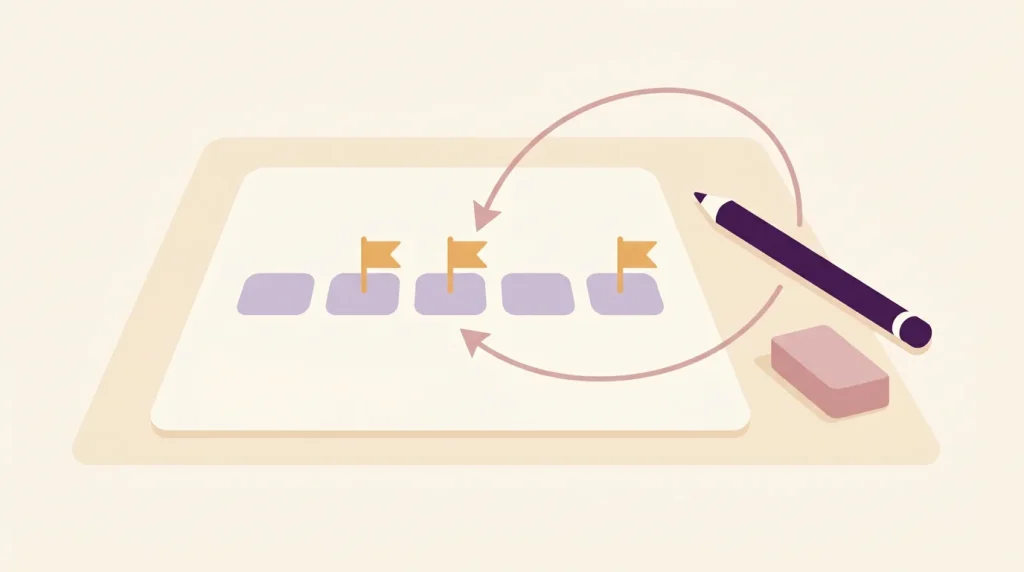
- Pass 2 (80–110 min): flagged questions only. Re-read the lead-in first. Change the answer only if you can articulate why in one sentence.
- Pass 3 (110–120 min): sanity check. Confirm every question has a recorded answer using the Surpass review screen. Submit.
The point of flagging is not perfectionism. It is to stop one toxicology question consuming the next ten easy paediatrics marks.
Why does flagging matter more on Surpass than on the old platform?
Pearson VUE and Ripley are gone. From January 2026 RCEM uses Surpass for MRCEM Primary, MRCEM SBA and FRCEM SBA. The Surpass interface gives you a clear flag-for-review toggle on every question and a review screen at the end showing answered, unanswered and flagged items at a glance. If you have only ever done untimed bank questions in your browser, the test-day UI will feel different — smaller text box for the stem, clearer navigation panel, and a visible question counter ticking down.
For more on this, see our guide to MRCEM SBA pacing strategy.
Two consequences for strategy:
- The review screen makes a structured second pass cheap. You can jump straight to flagged items rather than scrolling.
- You must practise on a desktop, ideally full-screen, before exam day. Phone revision is fine for content but does not train the click-flag-move rhythm.
How much time should each pass take?
The maths is unforgiving but it is on your side if you respect it. With 7,200 seconds and 90 questions:
- First pass: ~55 seconds per question average, target finishing question 90 by the 80-minute mark.
- That leaves 30–40 minutes for flagged items and a final sanity sweep.
- Realistically you will spend 30–45 seconds on easy clinical stems and bank the time for the 90-second slow ones.
Set mental checkpoints: question 30 by 27 minutes, question 60 by 54 minutes, question 90 by 80 minutes. If you are behind at any checkpoint, you are spending too long agonising. Flag harder and keep moving.
When exactly should you flag a question?
Flagging is a triage decision, not an emotional one. The trigger is simple: at 60 seconds, if you still cannot commit to one option, you flag. But it helps to know why you are stuck, because the right second-pass action depends on it.
Common flagging triggers and the right response
| What you noticed at 60 seconds | First-pass action | Second-pass action |
|---|---|---|
| Two options look equally correct — you are stuck on “best” vs “correct” | Pick the one most aligned with current UK EM practice. Flag. | Re-read the lead-in only. Often “initial” vs “definitive” or “most likely” vs “most appropriate” decides it. |
| You have never seen the condition (a true gap) | Eliminate the two clearly wrong options, guess between the rest. Flag. | Leave the answer. You will not magically remember a fact you never learned. |
| Long stem you have not finished reading | Skip to the lead-in question, answer based on the obvious diagnosis if any. Flag. | Read the full stem properly — the buried detail (drug, allergy, observation) usually reframes the answer. |
| Statistics, p-value, sensitivity/specificity calculation | If the maths takes >30 seconds, commit a best guess. Flag. | Re-do the calculation cleanly with the on-screen calculator (Surpass has one). |
| Image or ECG you cannot interpret | Match clinical stem to commonest diagnosis fitting that pattern. Flag. | Cover the answers, re-describe the image in your own words first. |
| You feel “trickyness” — suspecting a trap | Pick the boring, common answer. Flag. | Trust the horse, not the zebra. Change only with explicit evidence in the stem. |
| Governance, ethics, complaint, SUI | Choose the safest, most patient-centred, most policy-aligned option. Flag. | Re-read with a consultant-level frame: what would the GMC and your TPD both endorse? |
| You realise mid-question you have used >90 seconds | Stop. Guess. Flag. Move. | Treat as a true uncertainty — do not just rubber-stamp your guess, but do not start from scratch either. |
What is the right way to use the Surpass review screen?
The end-of-paper review screen shows three states for every question: answered, unanswered and flagged. Work them in this order:
For more on this, see our guide to common FRCEM SBA mistakes that cost marks.
- Unanswered first. These should be zero by pass 2. If any exist, fill them in. Even a 1-in-5 guess is +20% expected marks per question vs blank.
- Flagged questions, in the order you flagged them. Your earlier self has done the hard thinking — trust the triage. Spend no more than 90 seconds per flagged item.
- One final scan of the answered list only if time remains. Do not re-open questions you were confident about. See the next section.
Should you change your first answer?
This is where candidates lose the most marks. The folklore is “always trust your first instinct.” The evidence says otherwise. A widely cited review of multiple-choice answer changing in NIH-indexed medical education literature and a 2021 study of 157 university physiology exams both found that changes from wrong to right outnumber changes from right to wrong — the “first instinct fallacy” is a real thing. But there is a critical caveat. The benefit only appears when:
- You flagged the question because you were uncertain at the time of answering, and
- You re-read the lead-in and spot a specific reason to change — not a vibe.
Translated to FRCEM SBA: change a flagged answer only if you can finish the sentence “I am changing this because…” with a concrete fact from the stem. Do not change confident answers you did not flag — that is where the “right to wrong” damage happens.
What if you fall behind the clock?
It happens to most people, usually around question 35–45 when fatigue first bites. The recovery protocol:
- Acknowledge it at the next checkpoint (don’t pretend you’ll catch up gradually — you won’t).
- Drop your flagging threshold from 60 seconds to 30 seconds for the next 15 questions.
- Commit to the obvious answer on every long-stem question. Reading every nuance is a luxury you no longer have.
- Skip nothing. Even pressured guessing is better than running out of paper.
If you are still behind at question 60, accept that pass 2 will be much shorter. Better a complete paper with weaker flagged-question revision than a beautifully reviewed first 70 questions and 20 blanks.
How should you train flagging during revision?
The biggest mistake is doing all your bank questions untimed and only practising flagging in mocks. By then it is a stress behaviour, not a skill. From three months out:
- Every question block is timed at ~75 seconds per question, not 80. Train fast, exam at exam pace.
- Use the flag function in your question bank even when you don’t strictly need to. Build muscle memory.
- Do at least two 90-question mock papers on a desktop browser, full-screen, with the navigation panel open. Simulate Surpass conditions.
- Audit your flagging accuracy. After each mock, look at how often your flagged questions were ones you got wrong vs how often unflagged questions were wrong. If you are flagging questions you ended up answering correctly without changing, your threshold is too aggressive.
- Practise the review-screen workflow: finish a 30-question block, then deliberately revisit flagged items only.
What about Paper 2 stamina?
You have a one-hour break between papers. Most candidates underestimate how much the morning paper drains decision-making capacity for the afternoon. Three practical things:
- Do not debrief the morning paper. Eat, walk, hydrate. Talking to other candidates is purely downside.
- Expect your flagging threshold to drift looser in Paper 2. That is fine — flag more, not less, when fatigued.
- Plan your three passes the same way, but assume your sanity-check pass will be shorter. Front-load discipline in pass 1.
Frequently asked questions
Is the flag button definitely available on Surpass FRCEM SBA?
Yes. Surpass has a standard flag-for-review function on every question, plus an end-of-paper review screen showing answered, unanswered and flagged items. RCEM moved to Surpass from January 2026, so this is the live UI for all 2026 sittings. If you want a feel for the platform, the Royal College of Surgeons publishes a Surpass candidate guide that uses the same core interface.
Is there negative marking on FRCEM SBA?
No. Every unanswered question is a wasted mark. Guess on anything you cannot answer, even in the final 30 seconds.
What is the pass mark?
RCEM uses the Angoff method plus one standard error of measurement to set the pass mark for each sitting — it is not a fixed 65%. In practice it sits in the mid-60s. The official Angoff explainer (PDF) describes the methodology.
How many questions should I expect to flag?
Most candidates who pass flag 15–25 questions per paper. Fewer than 10 usually means you are over-committing on first pass and missing nuance. More than 30 usually means you are using flag as procrastination — commit harder on first pass.
Should I read all five options before deciding?
Yes, always. SBA is “best answer,” not “first correct answer.” You will hit two plausible options on at least 20% of questions. Read all five, then decide.
Lead-in first or stem first?
Lead-in first. Read the actual question (“what is the most appropriate initial step?”), then read the stem with that filter active. This stops you generating a diagnosis the question isn’t even asking about.
What if I get a software glitch on the day?
Raise your hand immediately and tell the invigilator. Surpass logs your in-progress answers, but a documented incident at the time matters for any subsequent appeal. Do not try to “work around” it — that wastes minutes you cannot get back.
Can I write notes during the exam?
You will be provided with a wipeable noteboard or similar at the test centre — check the current RCEM exam regulations for the rules at your sitting. Use it for stats calculations and tracking time checkpoints, not for re-writing stems.
Should I flag questions I got quickly but felt unsure about?
Yes. Speed and confidence are different things. The whole point of flagging is to mark uncertainty so your second-pass self can re-read.
Should I change a flagged answer if I have no new reason, just doubt?
No. The evidence on answer-changing supports change when you spot a specific reason — a missed detail, a misread lead-in, a calculation error. Pure doubt is not enough and tends to convert correct answers to wrong ones.
Is it worth using the Surpass colour-scheme preferences?
If high-contrast or dark-mode helps you read faster, yes — set it before you click into the paper, not mid-exam. Do not change it on the day if you have never used it during practice.
How do I stop panicking when I see three flagged questions in a row?
Three flagged questions in a row is normal — the SBA deliberately clusters difficulty. The panic comes from believing each flag is a failed question. It is not. It is a deferred decision, exactly as designed. Keep moving.
Next step
If you are revising for a 2026 sitting, the single highest-yield change you can make this week is to time every question block at 75 seconds per question and use the flag function deliberately. For curriculum-mapped FRCEM SBA practice with full mock papers and the review-screen workflow built in, head to emfinalexams.com.
Facts last verified .
Ready to build your plan? EMF Premium gives you all 40,000+ questions, 20 mocks and 1,215 OSCE stations from £29/month — or a one-off 3- or 6-month pass.