Facts last verified .
If you are revising for the MRCEM OSCE on your own, you already know the problem. The official college advice is to practise with peers under exam conditions, and most posts on r/doctorsUK echo the same line: “find a study partner.” That is fine if you work in a busy teaching trust with five other MRCEM hopefuls down the corridor. It is no help at all if you are an IMG on a remote rotation, an LTFT trainee with school pickups, or the only EM SHO in a small DGH whose colleagues are all sitting different exams.
The good news: in 2026, the resources for genuinely useful solo OSCE practice are better than they have ever been. AI simulated patients, virtual examiners, recorded self-review and structured partner-matching platforms have closed most of the gap. You will still want at least one or two live human run-throughs in the final fortnight, but you can build 80 per cent of your competency entirely on your own. This guide tells you exactly how.
TL;DR — the four solo methods that actually move the needle
If you only do four things between now and exam day:
- AI simulated patients — Geeky Medics, OSCE AI Pro, MLAbuddy or a custom ChatGPT prompt. Voice mode is closest to the real thing. Aim for 3–5 stations a day.
- Self-recorded video review — phone propped on a textbook, run the station out loud, watch back at 1.25x. You will spot filler words, missed safety-nets and broken structure within one viewing.
- MedAll & Discord partner-matching — free virtual rooms with other candidates from across the world. Time-zone awkward but partner-free.
- A non-clinician helper for communication stations — a partner, parent or flatmate reading a printed patient script is good enough for breaking bad news, angry parent and safeguarding stations.
Everything below is the "how" for each.
For more on this, see our guide to MRCEM OSCE practice timeline before the exam.
Why is finding an MRCEM OSCE study partner so hard?
The MRCEM OSCE has 18 stations — 16 scored plus two rest — each eight minutes long with one minute reading time, per the Royal College of Emergency Medicine. To rehearse that breadth with a partner you ideally want someone at roughly the same stage, free at the same hours, willing to play patient and examiner, and prepared to give you honest feedback. In practice that combination is rare.
Most solo candidates fall into one of four buckets:
- IMGs revising from outside the UK with no peers sitting RCEM exams.
- LTFT or parent trainees whose only study windows are after 9pm.
- Geographically isolated SHOs in DGHs where no one else is at OSCE stage.
- Resitters whose original study group has now passed and moved on.
Recognising which bucket you are in helps you pick the right mix below. An IMG on night shifts will lean heavily on AI; an LTFT parent might get more from a non-clinician helper at the kitchen table.
What does "good" solo practice actually look like?
Solo practice fails when it becomes silent re-reading. It works when it is verbal, timed and reviewed. The minimum viable session is:
- One minute reading — read the candidate stem aloud, set a phone timer for eight minutes.
- Eight minutes performance — speak the entire encounter out loud, even the silences. If you would say it to a real patient, say it now.
- Two minutes feedback — mark yourself against the examiner checklist, write one thing to fix.
That is an eleven-minute block. Five blocks is one hour and covers more ground than most three-hour silent reading sessions.
Which solo method should I use for which station type?
Not every method works for every station. The table below is the quick mapping.
For more on this, see our guide to history-taking station framework.
| Method | Best for | Weak for | Cost (May 2026) | Setup time |
|---|---|---|---|---|
| AI simulated patient (text or voice) | History taking, counselling, breaking bad news, angry patient | Hands-on examination, procedural, resus team leading | Free tier on Geeky Medics; £15–30/mo for full access | 5 min |
| Self-recorded video review | Examination sequences, structured presentations (SBAR/SOCRATES), procedural patter | Reactive communication (no live foil) | Free (phone + tripod or stack of books) | 2 min |
| MedAll / Discord partner-matching | Full mock circuits, peer feedback, accent exposure | Last-minute revision (slots fill 1–2 weeks ahead) | Free | 15–30 min to register |
| Non-clinician reading a script | Communication stations, ethics, complaint handling, safeguarding | Anything needing a clinical response | Free | 10 min to brief them |
| Mannequin/pillow + checklist | ALS, paediatric BLS, fascia iliaca block, joint exam | Communication and softer skills | Free (pillow); £40–80 for a basic ALS torso | 5 min |
How do I use AI simulated patients for MRCEM OSCE practice?
AI virtual patients are the single biggest change in solo OSCE prep since 2024. The 2024 JMIR Medical Education feasibility study on GPT-driven chatbots for history taking found candidates rated the experience as realistic enough to surface the same diagnostic clues a human actor would, and a 2025 comparison study in PMC (PMC12750692) showed checklist scores from AI chatbot practice were comparable to peer role-play across history, examination, education and rapport domains.
Three options worth your time:
- Geeky Medics virtual patients — 800+ AI patients mapped to UKMLA presentations. Voice or text. Free tier; paid tier unlocks the AI examiner that auto-marks against a checklist. Best for history-taking and counselling.
- OSCE AI Pro / MLAbuddy — UK-flavoured AI patients with instant checklist feedback. Useful if you want a different patient "voice" to avoid getting too used to one platform.
- Custom ChatGPT or Claude prompt — free and infinitely flexible. Paste a station stem and ask the model to play the patient, refuse to break character, and give checklist feedback afterwards. Sample prompt at the end of this section.
The trick is to speak, not type. Typing makes you concise and tidy in a way the real exam will not. Use voice mode or speak out loud while typing.
For more on this, see our guide to acing OSCE communication stations.
A starter prompt for ChatGPT/Claude as a simulated MRCEM patient
You are a 62-year-old woman attending the Emergency Department with chest pain. You have hypertension and smoke 10/day. The pain came on at rest, radiates to your jaw, and you feel sweaty. You are anxious but lucid. Stay in character. Only answer what I ask. Do not volunteer the diagnosis. Give realistic, brief replies (1–2 sentences). When I say "end station", drop character and mark me against an MRCEM OSCE checklist for cardiac chest pain history, scoring: opening & introduction, presenting complaint, risk factors, ICE, safety-netting, closure. Suggest the top three things to fix.
Run that prompt five times with five different presentations (chest pain, headache, painful red eye, postnatal woman with breathlessness, paediatric fever) and you have a structured hour of communication-station practice with feedback.
How do I self-record and review without cringing?
Everyone hates watching themselves back. Do it anyway — it is the highest-yield free intervention in solo prep. Multiple OSCE preparation guides, including RehearseMD and the MRCPI study technique blogs, list video self-review as a top-five technique specifically because it reveals nervous habits and broken structure that you cannot feel from the inside.
The setup:
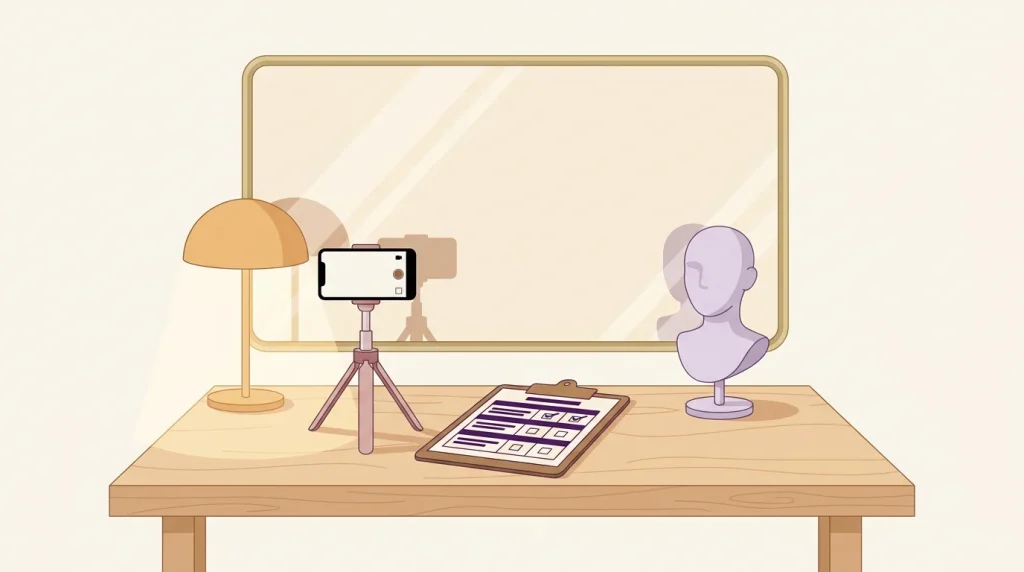
- Phone propped at chest height on a stack of textbooks or a £10 desk tripod.
- Print the candidate instructions for one station. Set a one-minute reading timer, then eight minutes performance.
- Speak the entire station out loud to an empty chair or a teddy bear. Yes, including "Hello, my name is…" and the closing safety-net.
- Watch back at 1.25x with the examiner checklist next to you. Tick what you did, circle what you missed.
- Re-run the same station 24 hours later without watching the recording again. Compare.
What you will catch in the first viewing, almost guaranteed: filler words ("sort of", "just"), no signposting, jumping into questions before introducing yourself, forgetting to wash hands in examination stations, no closure or safety-net.
You do not need fancy software. The native phone camera app is fine. If you want timestamps and easy review, free tools like Loom (15-minute limit on free) or a basic screen recorder work for stations where you also want to show your working on a virtual whiteboard (e.g. ECG interpretation).
How do online partner-matching platforms work, and are they worth it?
If you want live human practice but have nobody nearby, partner-matching platforms let you book a 30–60 minute slot with a stranger sitting the same exam. The biggest UK options:
- MedAll — partners with 2,000 medical societies, hosts free live events and on-demand courses including MRCEM OSCE prep sessions. Browse the Emergency Medicine speciality page and filter for OSCE.
- Geeky Medics partner-matching — their find a partner feature inside the OSCE Stations platform pairs you with another subscriber for live video practice.
- WhatsApp and Telegram MRCEM groups — ask in r/doctorsUK or on the EMAM/Bridge Medical alumni groups. Most sittings have an unofficial 100+ member WhatsApp by exam day; lurkers find practice partners through this faster than through any official channel.
- Discord study servers — smaller but reliable. The medicalschooluk Discord and various EM-specific servers run weekly OSCE rooms.
Caveats: time-zone planning matters if you are an IMG, slots fill 1–2 weeks ahead of any sitting, and quality varies. Treat the first session as a calibration — if your partner is engaged and gives useful feedback, book three more. If not, find someone else.
Can a non-clinician partner actually help?
Yes, for a narrower set of stations than you think. Communication-heavy stations — breaking bad news, angry parent, consent for a procedure, safeguarding, complaint handling — require an actor who can be sad, angry or confused on cue. They do not require an actor with clinical knowledge. Your partner, parent, flatmate or sibling can read a printed patient script and react.
The brief for them takes ten minutes:
- Give them the patient instructions only, not the candidate or examiner pages.
- Tell them: stay in character, only answer what is asked, do not volunteer information unless prompted, react emotionally if the script tells you to.
- After the eight minutes, give them the examiner checklist and ask: "Did I do these things? Tick or cross each one."
You will not get nuanced clinical feedback. You will get the one thing AI cannot give you: a real human watching your face, hearing your tone, and telling you whether you came across as warm or robotic. That is irreplaceable for the empathy-weighted stations.
What about examination, procedural and resus stations?
Communication stations are easy to solo. Hands-on stations are harder but not impossible.
- Examination stations (cranial nerves, abdomen, joint exam, paediatric exam) — rehearse on a pillow, a teddy bear, or a willing flatmate. The goal is sequence and patter, not the physical findings. Say each manoeuvre out loud ("I am now palpating the four quadrants, starting away from the area of pain") so the examiner hears your structure.
- Procedural stations (fascia iliaca block, chest drain, joint reduction, suturing) — cheap practice kits are widely available; a banana and 4-0 sutures will get you through suturing patter. For ultrasound-guided blocks, the patter and equipment check matter more than the actual needling skill on exam day.
- Resus / team leadership stations — these are the hardest to solo. Watch RCEMLearning podcasts and the Resus Room YouTube channel, then rehearse the ABCDE call-outs aloud against a manikin or pillow. If you can get one peer for one Zoom call to play the team, prioritise that for resus practice.
How should I structure a solo week in the final month?
A workable solo week, assuming you have two hours on weekdays and four on weekends:
- Mon — 5 AI history stations (voice), self-mark.
- Tue — 1 examination station, video record, watch back, redo.
- Wed — 3 communication stations with a non-clinician helper or AI angry-patient mode.
- Thu — 1 procedural patter run-through + 1 ECG/imaging interpretation station out loud.
- Fri — Rest or read RCEM curriculum gaps.
- Sat — Full 4-station mini-circuit on MedAll or Discord with strangers.
- Sun — Review week’s recordings, write down 3 fixes for next week.
That is roughly 30–40 stations a week. Over four weeks before the exam, you will have rehearsed 120+ stations — comfortably above what most paired candidates manage.
Frequently asked questions
Can I really pass MRCEM OSCE without ever practising with another doctor?
Yes, candidates do. It is not optimal — one or two live human run-throughs in the final fortnight catches blind spots no AI will. But the bulk of preparation can be solo, and many IMG passers report doing the majority of their work alone with virtual patients and recorded review.
Is the Geeky Medics AI examiner good enough as feedback?
For history-taking and counselling stations, yes — it marks against a structured checklist and gives written comments on communication. It is weaker on subtle non-verbal cues. Combine it with one self-recorded video per week so you also see your body language.
How realistic is ChatGPT or Claude as a simulated patient?
Surprisingly good with a tight prompt. The 2024 JMIR Medical Education study and the 2025 PMC comparison both rated GPT-driven simulated patients as realistic enough for history-taking practice, with comparable checklist scores to peer role-play. The weakness is emotional escalation — for an angry-parent or breaking-bad-news station, a human helper still wins.
What if I have no access to clinical equipment for examination stations?
You do not need much. A stethoscope, a tendon hammer and an ophthalmoscope cover most exam stations. Everything else can be mimed with patter; the examiner is marking your sequence and commentary, not the quality of your imaginary auscultation.
How do I avoid getting too used to AI patients and being thrown by real actors?
Mix sources. Rotate Geeky Medics, OSCE AI Pro and your own ChatGPT prompts so you encounter different "personalities." Then book at least two live sessions (MedAll, Discord or a paid course like Bromley Emergency or EMAM) in the final fortnight so your last impression is of a human responder.
Do I need to pay for a course?
Not strictly. Many passers use only free AI tools, self-recording and one or two MedAll sessions. A paid course (EMAM, Bromley, Bridge Medical, EM Learning Centre) is worth it if you want a single weekend of structured feedback from consultants and a sense of where you sit against the cohort. It is not a substitute for daily practice.
How do I find other MRCEM candidates to practise with online?
In order of yield: WhatsApp groups linked from any official MRCEM prep course, the MedAll Emergency Medicine page, the Geeky Medics partner-matching feature, r/doctorsUK threads in the 6–8 weeks before each sitting, and Discord servers like medicalschooluk and various EM-focused servers.
I am an IMG with no NHS experience. What should I add to my solo prep?
Spend deliberate time on UK communication norms: first-name introduction, "Is it OK if I ask you some questions?", ICE (ideas, concerns, expectations), safety-netting language ("If x happens, please come back or call 111"). Watch a few minutes of UK ED YouTube content (Geeky Medics channel, Resus Room) for accent and phrasing exposure before you do AI sessions.
How many stations should I aim to rehearse before exam day?
A reasonable target is 100–150 station attempts in the eight weeks before the exam. That is two to three a day. Quality matters more than count — a station you redo twice with feedback is worth four unreviewed run-throughs.
What is the single most common solo-prep mistake?
Silent reading. If you are not speaking out loud and being timed, you are not practising OSCE — you are revising for the SBA. The MRCEM OSCE is a performance, and performance only improves with rehearsal.
How do I keep motivation up when nobody else is studying with me?
Two things help. First, post a weekly check-in in any MRCEM WhatsApp or Discord group — even loose accountability with strangers raises adherence. Second, log your stations in a simple spreadsheet (date, station type, score, one fix). The visible progress is the motivator.
Does the RCEM allow recording of any official materials?
No — do not record or share actual exam content. Recording yourself running a publicly available practice station (Geeky Medics free station, EMAM blog station, a station you wrote yourself) is fine.
Next step
If you want a structured MRCEM OSCE plan that builds these solo methods into a week-by-week revision schedule, alongside SBA and Primary prep, browse the full course library at emfinalexams.com. Membership includes OSCE station banks, written examiner checklists you can use for self-marking, and timed mock circuits you can run alone or with a partner.
Facts last verified . Course prices, RCEM exam format and AI platform features change — check rcem.ac.uk and the relevant provider for the current sitting.
Ready to build your plan? EMF Premium gives you all 40,000+ questions, 20 mocks and 1,215 OSCE stations from £29/month — or a one-off 3- or 6-month pass.