
![[HERO] Mastering FRCEM Critical Appraisal: Common Pitfalls and How to Avoid Them](https://cdn.marblism.com/6_014fEm1D9.webp)
Critical appraisal questions in the FRCEM Final SBA can feel like a different language. While you’ve spent years managing resuscitations and navigating clinical guidelines, suddenly you’re expected to dissect study designs, interpret confidence intervals, and spot bias types, all within the time pressure of 180 questions in 3 hours.
The good news? Critical appraisal SBAs follow predictable patterns. Once you understand the common pitfalls and how to avoid them, these questions become some of the most straightforward marks you can secure. This guide focuses on SLO 11 (Critical Appraisal) from the 2021 RCEM curriculum and gives you practical strategies to tackle these questions confidently.
Why Critical Appraisal Matters for FRCEM
The 2021 RCEM curriculum emphasizes evidence-based practice. Critical appraisal isn’t just an academic exercise, it’s about developing the skills to evaluate research that influences your clinical decision-making. In the FRCEM Final exam, you’ll encounter SBAs testing your ability to identify study designs, interpret statistical results, and recognize sources of bias.
These questions aren’t designed to trick you. They’re testing whether you can quickly assess the quality and applicability of medical research. Master the fundamentals, and you’ll approach these SBAs with the same confidence you have when reading an ECG.

Common Pitfall #1: Misidentifying Study Designs
One of the most frequent errors candidates make is misclassifying the type of study being described. When you misidentify the study design, every subsequent answer about bias, analysis, and interpretation becomes unreliable.
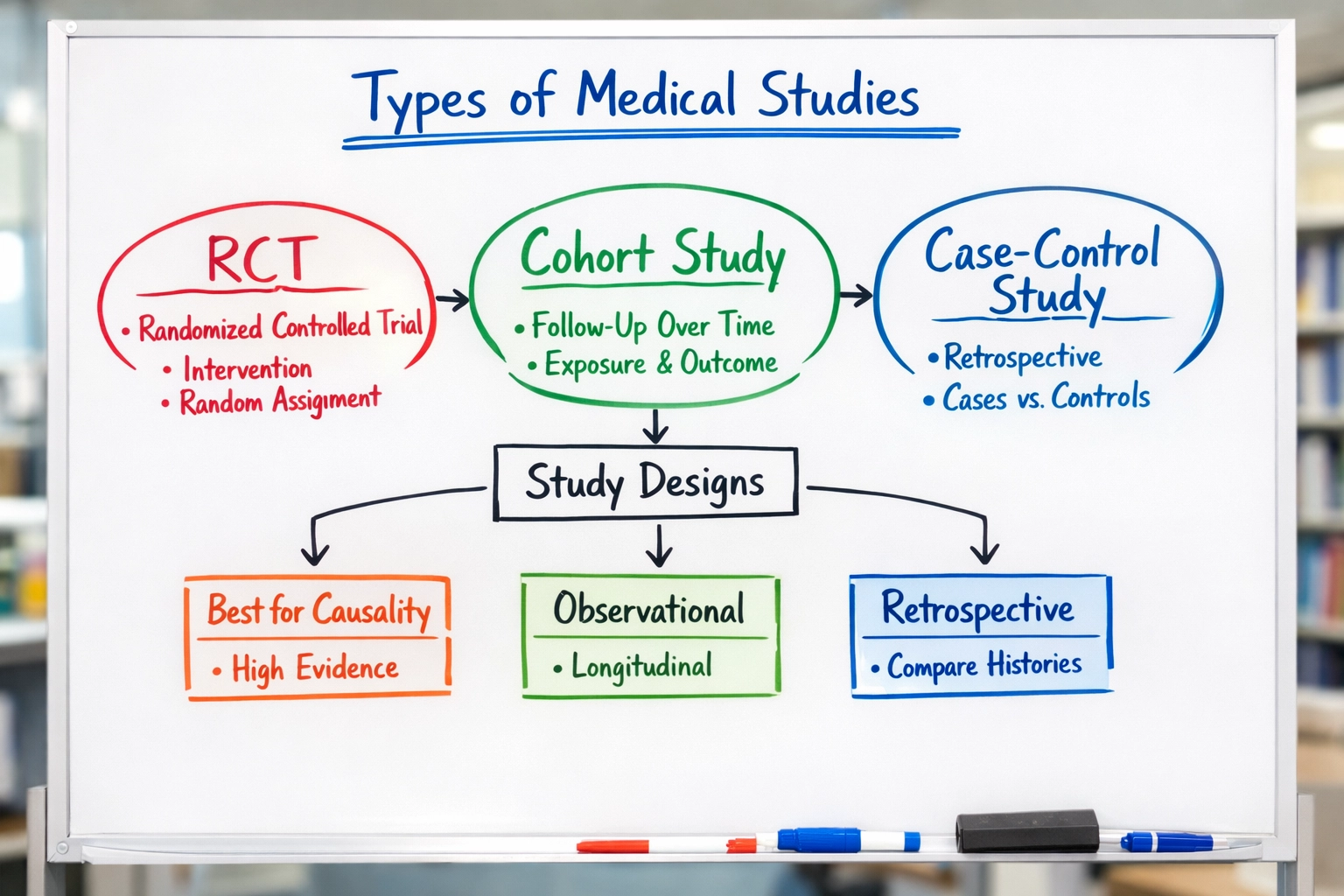
The fix: Create a mental flowchart for study designs. Start with the fundamental question: Is there an intervention? If yes, you’re likely looking at an experimental study (RCT, quasi-experimental). If no, it’s observational (cohort, case-control, cross-sectional).
For diagnostic test studies, pay attention to whether researchers are comparing a new test against a gold standard. Case-control studies work backwards from outcome to exposure: patients with the disease (cases) are compared to those without (controls). Cohort studies follow people forward in time based on exposure status.
Exam tip: The stem often contains key phrases that signal the study design. “Randomised into two groups” = RCT. “Patients with confirmed MI were compared to matched controls” = case-control study. “Healthcare workers were followed for 12 months to assess infection rates” = cohort study.
Common Pitfall #2: Over-Complicating Statistical Terms
Statistics can feel overwhelming, but FRCEM critical appraisal SBAs don’t require advanced mathematical knowledge. They test your understanding of concepts, not your ability to calculate them.
Confidence Intervals
Many candidates panic when they see confidence intervals, but the concept is straightforward. A 95% CI tells you the range where the true population value likely sits. If the CI for a relative risk or odds ratio crosses 1.0, the result isn’t statistically significant: the effect could be beneficial, neutral, or harmful.
Wide confidence intervals suggest imprecision: the study didn’t have enough participants to give a precise estimate. Even if the point estimate looks impressive, wide CIs should make you cautious about the findings.
P-Values
Remember: a p-value <0.05 simply means there’s less than a 5% probability the result occurred by chance alone. It doesn’t tell you whether the finding is clinically important. A study might show a statistically significant reduction in blood pressure (p=0.03), but if the reduction is only 2 mmHg, is it clinically meaningful? Probably not.
Number Needed to Treat (NNT)
NNT tells you how many patients need to receive the intervention for one additional patient to benefit. An NNT of 5 means you treat 5 patients for 1 to benefit. Lower is better (NNT of 2 is more impressive than NNT of 50). For harmful outcomes, we use NNH (Number Needed to Harm): same principle, different context.
Exam strategy: Don’t try to calculate these values during the exam. Focus on interpreting what the numbers mean for clinical practice. If a question asks about NNT, they’ll usually give you the calculation or ask you to interpret a given value.
Common Pitfall #3: Poor Time Management
With 180 questions in 3 hours, you have exactly 60 seconds per question. Critical appraisal SBAs can consume more time if you get bogged down in the details of the study abstract.
Time-saving framework: Use the OMRC structure: Objectives, Methods, Results, Conclusions. When you read the abstract, identify these four components quickly:
- Objective: What were the authors trying to find out?
- Methods: What type of study did they do, and how?
- Results: What did they actually find (numbers, statistical significance)?
- Conclusions: What do the authors claim their findings mean?
Check that these sections align logically. A common error in poorly conducted studies is when conclusions don’t match the results, or when the objective asks one question but the results answer something completely different.
In the exam: Skim the abstract once to identify these sections, then go straight to the question. Often you only need to refer back to one specific section of the abstract to answer correctly. Don’t waste time understanding every detail of the methodology when the question only asks about the conclusion’s validity.
Recognizing Bias in Diagnostic Test Studies
Diagnostic test questions are high-yield for FRCEM critical appraisal SBAs. Two specific bias types appear repeatedly:
Incorporation bias occurs when the diagnostic test you’re evaluating becomes part of the reference standard (gold standard). This artificially inflates specificity because the test can’t disagree with itself. For example, if you’re testing a new cardiac biomarker but include that biomarker in your definition of “confirmed MI,” you’ve introduced incorporation bias.
Work-up bias (verification bias) happens when not all patients receive the reference standard test. Instead, only patients with positive results on the new diagnostic test get the gold standard test. This overestimates sensitivity because you’re missing the false negatives who weren’t followed up.
The solution: The person interpreting the diagnostic test must be blinded to the reference standard results, and vice versa. All participants should receive both tests, regardless of initial results.

Practical Tips for Mastering Critical Appraisal SBAs
1. Start with the Basics
Before diving into practice questions, ensure you understand fundamental concepts: sensitivity, specificity, positive and negative predictive values, types of bias (selection, information, confounding), and basic study designs. These building blocks appear across multiple critical appraisal SBAs.
2. Learn the Language
Critical appraisal has specific terminology. Know the difference between internal validity (did the study measure what it claimed?) and external validity (can we apply these findings to our population?). Understand what “blinding” and “allocation concealment” mean in RCTs. Recognize terms like “intention-to-treat analysis” and why it matters.
3. Practice with Real Abstracts
Reading the methodology sections of papers in Emergency Medicine journals helps you recognize common study structures. When you read a study abstract, pause and ask yourself: What’s the design? What biases might exist? Are the conclusions justified by the results?
4. Focus on High-Yield Topics
The RCEM curriculum prioritizes certain areas within critical appraisal. Study designs (particularly RCTs, cohort studies, and case-control studies), bias recognition, and statistical interpretation form the core of most SBAs. Master these before moving to more specialized topics.
5. Time Yourself
Practice critical appraisal questions under timed conditions. Set yourself 60 seconds per question to simulate exam pressure. This trains you to extract relevant information quickly without getting distracted by irrelevant details in the abstract.
How to Practice Effectively
Effective preparation requires exposure to FRCEM-style critical appraisal SBAs that mirror the exam format. EMF Free offers 30 critical appraisal SBAs specifically aligned with the 2021 RCEM curriculum, giving you a solid foundation to identify your knowledge gaps and build confidence with question style and timing.
For comprehensive preparation across all curriculum areas, EMF Premium provides access to over 40,000 SBAs for £20/month: a complete FRCEM SBA question bank covering not just critical appraisal but every domain of the Final exam. This includes detailed explanations that reinforce learning and help you understand not just the right answer, but why the other options are incorrect.
Regular practice with high-quality SBAs trains pattern recognition. You’ll start noticing recurring question formats, common distractor answers, and the specific ways examiners test critical appraisal concepts.
Moving Forward with Confidence
Critical appraisal SBAs don’t need to be intimidating. By avoiding the common pitfalls: misidentifying study designs, over-complicating statistics, and poor time management: you can approach these questions systematically and score consistently well.
Focus on understanding core concepts rather than memorizing formulas. Practice with curriculum-aligned questions to build familiarity with exam style and timing. And remember: these SBAs test practical interpretation skills that will serve you throughout your career, not just on exam day.
Start with the fundamentals, practice regularly, and you’ll find that critical appraisal becomes one of your strengths in the FRCEM Final SBA.