Facts last verified .
TL;DR: The MRCEM Intermediate SBA is 180 single best answer questions delivered as two papers of 90 questions, two hours each, sat on the same day with a one-hour break between papers. That gives you roughly 80 seconds per question (2 hours ÷ 90 = 1 min 20 sec). Total testing time is 4 hours; expect to be in the Surpass test centre for around 5 hours once you include the break and check-in.
How long is the MRCEM Intermediate SBA exam?
Four hours of testing, split across two papers on a single day, with a one-hour break sandwiched between them. The Royal College of Emergency Medicine confirms the structure in its current MRCEM Exam Regulations: 180 SBAs delivered as two two-hour papers, 90 questions per paper. Add check-in, ID verification and the mandatory break and you are realistically committed to the test centre for about five hours, door to door.
The exam runs at Surpass Assessment test centres worldwide. RCEM moved its theory papers from Pearson VUE to Surpass from January 2026 onwards, which changed the booking flow and some of the on-screen tooling but did not change the exam structure, duration or pacing. You sit it on a workstation under invigilation; both papers must be completed on the same day at the same centre.
If you are planning your study calendar backwards from a sitting, treat the exam as a full clinical-shift commitment, not a half-day. Most candidates report being mentally finished by the time they walk out, and arrival times at UK Surpass venues can be as early as 08:30 for a 09:00 start.
How many questions, and how much time per question?
Ninety questions per paper, 120 minutes per paper, so the working pace is 80 seconds per question. That is not generous, but it is workable if you keep a steady rhythm. Most candidates who run out of time have spent too long on the first ten to fifteen items, not the last few — the early-paper anxiety trap is real and almost always costs more than the late-paper time crunch.
Plain-text key facts:
- Total questions: 180
- Papers: 2
- Questions per paper: 90
- Time per paper: 2 hours (120 minutes)
- Break between papers: 1 hour
- Time per question: ~80 seconds (1 min 20 sec)
- Total testing time: 4 hours
- Typical day at the centre: ~5 hours including check-in and break
- Delivery: Surpass Assessment test centres (worldwide)
- Format: machine-marked SBA, no negative marking
- Curriculum mapping: Year 1–3 Specialty Learning Outcomes of the 2021 RCEM EM Curriculum
What is the paper-by-paper structure?
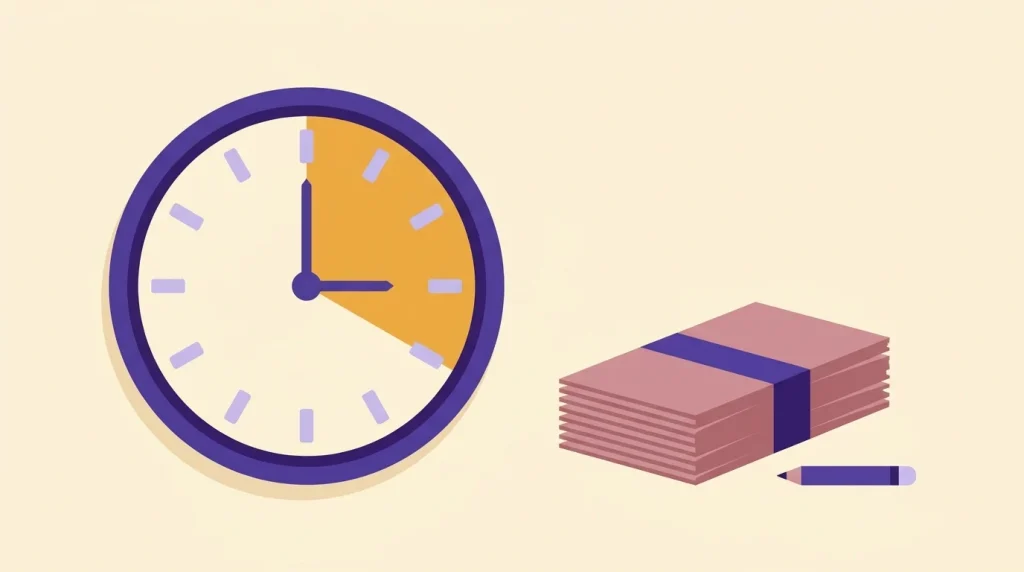
Both papers are identical in length and weight. They are not labelled “easy” and “hard” — the syllabus is drawn from the same Year 1–3 Specialty Learning Outcomes of the 2021 RCEM curriculum across both. The break is non-negotiable and you cannot bank time from one paper to use in the other. Answers from paper 1 are locked when you submit; you cannot return to them during paper 2.
| Component | Paper 1 | Break | Paper 2 | Total |
|---|---|---|---|---|
| Questions | 90 SBAs | — | 90 SBAs | 180 SBAs |
| Duration | 2 hours | 1 hour | 2 hours | 5 hours scheduled |
| Time per question | ~80 sec | — | ~80 sec | ~80 sec average |
| Marking | 1 mark correct, 0 incorrect | — | 1 mark correct, 0 incorrect | No negative marking |
| Flag / review | Within paper only | — | Within paper only | Cannot revisit paper 1 in paper 2 |
| Delivery | Surpass workstation | Leave testing room | Surpass workstation | Same centre, same day |
What does the timing actually feel like in the exam?
Tight, but fair if you have practised under timed conditions. The recurring theme on r/doctorsUK and in candidate debriefs is that pacing — not knowledge gaps — is what catches people out. SBAs at this level are designed to test clinical reasoning, so the stems are longer than the MRCEM Primary. If you read every stem twice and re-read every option before committing, you will overrun. The questions reward decisive readers who commit to a working answer in 60–80 seconds and only re-read on flagged items.
A practical rhythm that works for most candidates:
- Minutes 0–60 (Q1–45): aim to be at question 45 by the one-hour mark. If you are at question 30, you are already behind and need to consciously speed up. Do not look back from this point.
- Minutes 60–100 (Q46–75): keep moving. Flag anything you cannot answer in 90 seconds and come back. Trust your first instinct on stems you have seen before in practice — second-guessing burns time and rarely improves accuracy.
- Minutes 100–120 (Q76–90 + flagged): finish the run, then revisit flags. Never leave a question blank — there is no negative marking, so a random guess beats a zero every time.
If the timer gets ahead of you mid-paper, the standard recovery move is to commit a best-guess on the next five questions in under three minutes total to claw back the deficit, then return to normal pace. Slow-and-thorough is not a recoverable strategy once you are 10+ questions behind schedule.
How should I use the one-hour break between papers?
Treat it as recovery, not revision. The break is fixed at 60 minutes, which is enough to leave the test centre, eat something substantial, hydrate and re-set. Do not pull out notes. Two hours of concentrated SBA work is genuinely fatiguing and the second paper has the same pass weight as the first. Going in tired or hungry costs more marks than any last-minute fact will save.
A short break checklist:
- Eat protein plus a slow carb, not just caffeine and sugar.
- Drink water; alcohol and excess caffeine will both hurt paper 2.
- Step outside if you can — daylight resets focus better than corridor pacing.
- Phone off, or in airplane mode. No exam chatter with colleagues sitting the same paper — it spikes anxiety with zero upside.
- Use the toilet, even if you do not feel you need to. There is no second chance.
If you wear contacts, bring drops. If you are prone to caffeine crashes, time your coffee around the second paper, not the first.
Can I leave the test centre during the break?
Yes — the one-hour break is yours. You will sign out, leave personal items in a locker, and sign back in with ID before the second paper. Build in 10–15 minutes of buffer at each end. If the test centre is in an out-of-town business park (many Surpass venues are), confirm food options the day before so you are not hunting for a sandwich with 20 minutes left on the clock.
You cannot take any exam material out of the testing room, and the rough-paper/whiteboard provided is collected at the end of each paper. Phones stay in the locker. Some candidates pre-pack a lunch the night before and eat it in the centre’s break area to avoid the food-hunting risk entirely — a sensible default if you have not visited the venue before.
Is the MRCEM SBA always delivered on a single day?
Yes. Both papers are sat on the same day at the same Surpass test centre, separated only by the one-hour break. You cannot split them across two sessions, and there is no “morning only” or “afternoon only” option. The 2026 sitting dates are 21 January 2026 and 16 September 2026 — the next published exam window after this article was verified is September 2026, with applications opening 10 June 2026 and closing at 16:00 UK time on 17 June 2026.
If you cannot complete both papers on the same day for medical reasons, the route is a transfer request to the Head of Exams with supporting evidence — not a split sitting. RCEM’s published policy is to transfer eligible candidates to the next available sitting, not to reschedule within the same window.
How does the SBA timing compare to MRCEM Primary and FRCEM SBA?
The MRCEM Primary gives you slightly more time per question (3 hours for 180 SBAs = 60 seconds per question, but in one continuous sitting). The FRCEM SBA uses the identical 2 × 2-hour structure as MRCEM Intermediate — same 90 questions per paper, same one-hour break. If you have already sat the Primary, the per-question pressure feels similar; the difference is the stem length and the clinical reasoning load, not the clock.
Three-line comparison:
- MRCEM Primary: 180 SBAs, 3 hours, single sitting, ~60 sec/Q. Basic sciences focus.
- MRCEM Intermediate SBA (Part B): 180 SBAs, 2 × 2 hours with 1-hour break, ~80 sec/Q. Clinical reasoning across Year 1–3 SLOs.
- FRCEM SBA: 180 SBAs, 2 × 2 hours with 1-hour break, ~80 sec/Q. Higher training SLOs.
What does the timing mean for your revision plan?
Two things, both non-optional. First, every full mock you sit in the last six weeks should be 90 questions in 120 minutes — not 60 questions in 90 minutes, not untimed. The mismatch between practice pacing and exam pacing is the most common avoidable failure mode. Second, you should sit at least one back-to-back double mock (90Q, 1-hour break, 90Q) before the real day. Paper 2 fatigue is a different animal from paper 1 alertness; you need to know what it feels like before it counts.
If your question bank lets you mix subjects in 90-question blocks, switch from topic-wise to mixed at the eight-weeks-out mark. Topic-wise practice flatters your recall; mixed practice flatters nobody and matches the exam.
Frequently asked questions
Is the MRCEM Intermediate SBA the same as MRCEM Part B?
Yes. “MRCEM SBA”, “MRCEM Intermediate SBA”, “MRCEM Intermediate” and “MRCEM Part B” all refer to the same exam. RCEM renamed it from FRCEM Intermediate SAQ in August 2021.
How many questions can I afford to flag and revisit?
Realistically about 10–15 per paper. If you flag 25+, you will not have time to revisit them all. Better to make a confident first-pass guess on anything you cannot answer in 90 seconds and flag only the items where you can genuinely narrow it down to two options.
Is there negative marking on the MRCEM SBA?
No. Each correct answer scores 1, incorrect scores 0. Always answer every question — a blank is a guaranteed zero.
Can I take a toilet break during a paper?
Yes, but the clock does not stop. Use the one-hour break for proper toilet stops and treat in-paper breaks as emergencies only — a 5-minute exit eats nearly four questions of usable time.
What happens if my computer crashes mid-paper?
Raise your hand. Surpass workstations auto-save answers continuously, and invigilators are trained to resume your session without loss. Time may be added at the invigilator’s discretion. Do not panic and do not click randomly to “check” — wait for staff.
How long should I practise full-length timed mocks before the real thing?
Sit at least three full 90-question, two-hour mocks in the last month — ideally back-to-back with a one-hour break in between to simulate the full exam day. Fatigue in paper 2 is the single biggest unforced error and you cannot replicate it with 20-question quizzes.
Does the timer show seconds or only minutes?
The Surpass on-screen timer shows hours and minutes counting down. There is no per-question timer — you have to pace yourself. A useful trick: glance at the timer every 15 questions and confirm you are roughly on track (15 questions ~ 20 minutes).
What is the pass mark and how is it set?
The cut score is set using the modified Angoff method, with +1 Standard Error of Measurement added to create the final pass mark. There is no fixed percentage — it varies sitting to sitting. See historic data in our MRCEM Intermediate SBA pass percentage guide; historic pass rates have run in the 30–50% range.
How much does the MRCEM SBA cost in 2026?
£429 for RCEM members in the UK, £485 for members internationally, £525 for non-members in the UK and £609 for non-members internationally. Membership pays for itself if you are sitting more than one exam.
When do I get my results?
Approximately six to eight weeks after the exam date. Results are released to your RCEM account by 17:00 on the published results date. Not by phone, not by email.
Can I look back at paper 1 answers after the break?
No. Paper 1 closes when you submit it. The one-hour break is a hard partition between sittings, and paper 2 is a fresh window with its own 90 questions and its own 120-minute timer.
What should I bring to the test centre on the day?
Photo ID matching the name on your RCEM account, your confirmation email, water, snacks for the break and any reasonable-adjustment paperwork pre-approved by RCEM. Phones and watches go in the locker. Most centres provide a whiteboard and pen for working-out, collected at the end of each paper.
What is the next step once I have a date booked?
Build a timed-question habit. The single highest-yield change you can make is doing 90-question blocks under exam conditions at least once a week in the final month. Get your timing instincts right and the knowledge follows.
Next step: If you are working towards MRCEM SBA and want a structured timed-practice plan with full mock papers, start at emfinalexams.com.
Facts last verified 30 May 2026 against RCEM official sources (mrcem-exams, exam-regulations-policies, exam-calendar-fees).
Ready to build your plan? EMF Premium gives you all 40,000+ questions, 20 mocks and 1,215 OSCE stations from £29/month — or a one-off 3- or 6-month pass.