TL;DR. From January 2026, RCEM theory exams (MRCEM Primary, MRCEM SBA, FRCEM SBA) are no longer delivered through Pearson VUE — Surpass Assessment now runs the test centre network. The noise rules are broadly the same: you can bring foam earplugs or noise-reducing headphones into the room, most centres also keep a stock at the desk, and you can raise your hand to ask for a quieter seat if the room next door turns into a building site. Pack earplugs and over-ear defenders, arrive 30 minutes early, and don’t suffer in silence on the day — flag it to the invigilator and ask RCEM to log it after.
Facts last verified .
Why this article still mentions Pearson VUE
If you’ve been on Reddit or in the WhatsApp groups, you’ll have seen the horror stories: candidates next to road works, fire alarms mid-paper, someone weeping through another exam on the far side of a thin partition. Almost all that institutional memory is from the Pearson VUE era — search results haven’t caught up yet.
Here’s the current position:
- From January 2026, all RCEM theory exams are delivered by Surpass Assessment — both the test-centre network and the online-invigilation option. The first Surpass-delivered diet was the 21 January 2026 sitting.
- Pearson VUE is no longer involved in MRCEM Primary, MRCEM SBA or FRCEM SBA bookings. If your booking confirmation routes you through Pearson, it’s a legacy email — check your RCEM account.
- The day-of experience is recognisably similar. Surpass uses third-party test-centre venues with proctored desks, lockers, photo ID checks, and the same hand-raise-for-help convention.
So the noise question hasn’t gone away — it’s just moved providers. The advice below covers what Surpass actually does in 2026, and flags the Pearson-era rules for anyone still researching old threads.
For more on this, see our guide to RCEM exam day ID and check-in requirements.
Is the Surpass centre actually quieter than Pearson VUE was?
Depends on the venue. Surpass doesn’t own most of its UK or international centres — they sub-contract to local providers (often the same physical building Pearson used). The marketing line is “minimal distractions” and “consistent experience.” In practice you’ll find:
- Open-plan rooms with low partitions between candidates, similar to the Pearson Professional Centre layout. Everyone in the room is sitting different exams at different times — typing, mouse-clicking, the occasional cough, someone being escorted to the loo.
- Doors that open and close as candidates start, finish, or take comfort breaks. This is the single most common reported distraction.
- Building noise if the centre is in a shared office block (lifts, HVAC, the cleaner’s hoover on the floor above).
For MRCEM Primary — 180 SBAs in 3 hours — most candidates find the first 30-45 minutes hardest to settle into, then the room noise fades into the background. The risk isn’t the average noise level; it’s the unpredictable spike that pulls you out of a question.
Can I bring my own earplugs?
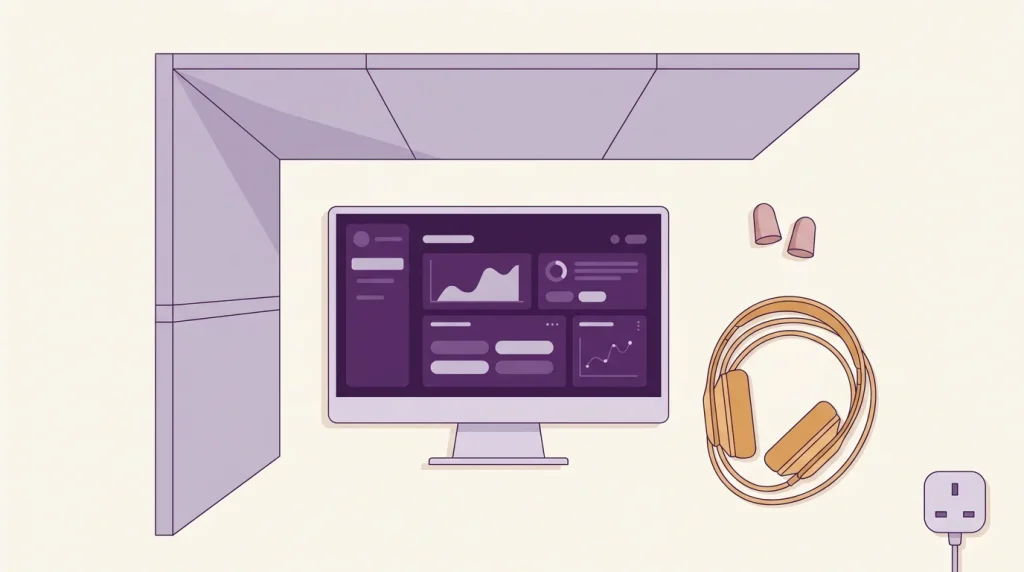
Yes. Both Surpass and (back in the day) Pearson VUE explicitly allowed foam earplugs and noise-reducing over-ear headphones as a comfort aid — no accommodation paperwork required, no doctor’s letter, no advance notice.
The legacy Pearson VUE rule (which Surpass mirrors) was that earplugs in Pearson Professional Centres had to be provided by the test centre; in third-party centres your own pair was fine on visual inspection. Surpass uses the same model — stock at the front desk on request, but bringing your own is safer.
For more on this, see our guide to RCEM exam centre locations UK.
Practical points:
- Bring basic foam earplugs (Mack’s, 3M E-A-R, Howard Leight — anything in a sealed packet you can open in front of the invigilator). Avoid wax plugs (they look suspicious to scan), reusable silicone with cases (the case won’t come into the room), and anything battery-powered.
- No active noise-cancelling headphones, no Bluetooth, no AirPods, no Loop earplugs that look electronic. If it has a microphone or any electronics, it stays in the locker.
- You can also layer — foam plugs inside passive over-ear defenders (the cheap industrial sort, NRR 25-30 dB) is the gold standard, and is the same combo recommended on the UCAT and MCAT subreddits.
Can I request a quieter room?
You can ask, but you usually can’t have one — not on the day, anyway.
A “separate room” at a Surpass or Pearson centre is a formal reasonable adjustment, which you have to apply for through RCEM at the point of booking (12 weeks before the exam) with supporting documentation — typically for ADHD, autism, anxiety disorders, or a documented noise sensitivity. If that’s you, the route is:
- Tick the reasonable adjustments box on your RCEM application form.
- Upload supporting evidence (occupational health letter, GP letter, educational psychologist report).
- RCEM emails you to confirm what’s been approved before exam day.
On the day itself, the test administrator can sometimes move you to a quieter seat (away from the door, away from the toilet corridor, end of a row) if you ask before you start the exam and if there’s space. They will not start a separate room mid-paper.
What if it’s too noisy once the exam has started?
The official Surpass / RCEM line, and the Pearson VUE rule it inherited, is straightforward: raise your hand. The test administrator (TA) will come over. Don’t shout, don’t get up, don’t take your headphones off and start a conversation with your neighbour. Hand up, wait.
For more on this, see our guide to MRCEM OSCE nerves on the day.
What the TA can do mid-exam:
- Hand you earplugs from the front-desk stock if you didn’t bring your own.
- Ask the source of the noise to stop (the cleaner, the candidate whispering to themselves, the door that someone’s holding open).
- Note the incident in the centre’s log.
What the TA generally cannot do:
- Stop your clock. The exam timer keeps running while they walk over and while they investigate. This is non-negotiable in both Pearson and Surpass-run sessions.
- Move you to a different room mid-exam.
- Restart the question you were on.
This is why earplugs in your pocket beat hand-raising every time — the mitigation has to be ready before the spike happens.
What does RCEM do if a whole sitting is disrupted?
Two scenarios to separate:
Single-candidate disruption (your neighbour’s alarm went off, the radiator banged for ten minutes, a fire drill at your centre only). RCEM’s standing policy — published on the theory exams FAQ — is to review feedback after the exam and consider it during the post-exam adjudication. There is no individual remark and no individual re-sit. What you can do:
- Make sure the TA logs the incident on the centre’s system on the day. This is the audit trail RCEM will look at later.
- Email exams@rcem.ac.uk within a week of the exam with a calm, factual account: time of incident, duration, what happened, what the TA did. Don’t editorialise.
- If you fail and you believe the disruption affected your result, this email is what your appeal will hinge on. Without it, there’s no record.
Centre-wide technical failure (system crash, building evacuation, power cut). RCEM’s published procedure is to work with Surpass to either resolve quickly, move you to a nearby centre, switch you to online invigilation, or — if none of that works — defer you to the next diet free of charge. On the day, call RCEM on +44 (0)20 7404 1999 to flag a significant issue; the centre will already be in contact with Surpass.
Pre-exam noise-mitigation checklist
The night before and morning of:
- Pack two pairs of foam earplugs in sealed packaging. One for the exam, one as a spare.
- Optional: passive over-ear defenders (industrial type, no electronics, ~£15 on Amazon). Some centres won’t allow them if they look like they could be Bluetooth — bring the receipt or box just in case.
- Wear them at home for at least an hour the day before. Foam plugs are uncomfortable if you’ve never worn them, and you don’t want to discover that during question 12.
- Drive past or look up the test centre on Google Street View. Centres in busy high streets, near rail stations, or next to construction sites are worth knowing about so you arrive mentally prepared.
- Arrive 30 minutes early. RCEM is strict about late arrivals — you forfeit your fee. Early arrival also gives you time to ask the TA for a seat away from the door, the toilet corridor, or the air-con vent before the room fills up.
- Use the loo before check-in, not after you’ve started. Every candidate going past your desk to be escorted out is a small noise event.
- Mention noise sensitivity at the front desk, even casually. Most TAs will quietly seat you somewhere sensible if they know.
What if I just can’t cope with the centre environment?
RCEM does offer online invigilation as a fallback, but it’s gated: “In some exceptional circumstances, candidates who cannot travel to a test centre to sit their theory exam may be considered to sit their exam remotely.” You’ll need two compatible devices (a computer plus a secondary phone or tablet for a second camera angle), a stable connection, and a private room you can guarantee is silent for the full three hours. You also have to email RCEM in advance — it’s not a day-of switch.
For most candidates, online invigilation introduces more noise anxiety, not less — a doorbell or housemate at the wrong moment can void the paper. If you’re choosing between a slightly noisy test centre and home invigilation, the centre is almost always the better bet.
FAQ
Can I bring earplugs to my MRCEM Primary?
Yes. Foam earplugs are an allowed comfort aid at Surpass test centres (and were at Pearson VUE) — bring them in sealed packaging, no doctor’s letter required.
Does the test centre provide earplugs?
Usually, yes. Both Surpass and Pearson VUE centres typically keep a stock of foam earplugs at the front desk. Ask at check-in. Bring your own as a backup — stock isn’t guaranteed at every centre on every day.
Can I wear noise-cancelling headphones?
No — active noise-cancelling headphones, Bluetooth headphones, AirPods and any electronics-containing earplugs (including some Loop models) are not permitted. Passive noise-reducing over-ear defenders (industrial type, no electronics, no microphone) are allowed in most centres.
Can I request a quieter room on the day?
No. A separate room is a formal reasonable adjustment you apply for at the point of RCEM booking, with supporting documentation. On the day, the test administrator may move you to a quieter seat if there’s space — ask before you start the exam, not after.
What do I do if a building alarm goes off during my exam?
Stay seated until the test administrator instructs you. Surpass and Pearson centres have evacuation protocols that pause and resume the exam where possible. If your paper is voided, RCEM will offer a re-sit at the next diet or a switch to online invigilation.
Will RCEM compensate me if my test centre was noisy?
Not in the form of a remark or individual re-sit, no. RCEM reviews feedback during the post-exam adjudication process led by the Lead Examiners. Email exams@rcem.ac.uk within a week of the exam with a factual account, and make sure the TA logged the incident at the centre on the day — that’s your audit trail.
Is the exam timer paused if I raise my hand?
No. The clock keeps running while the test administrator walks over and investigates. This is one of the strongest practical arguments for having earplugs in your pocket before the paper starts.
Do I have to apply for a noise accommodation in advance?
Only if you need a separate room, a different start time, or other formal adjustments. For earplugs, headphones, or simply asking for a seat away from the door — no advance application is needed.
What about online invigilation — is that quieter?
It can be, but you’re responsible for your own environment. You need two devices, a stable connection, and a private room you can guarantee will be silent for 3 hours. A doorbell, housemate, or even a barking dog can void the exam. Most candidates find a test centre less anxiety-inducing.
Is the Pearson VUE noise policy still relevant?
The provider has changed (Surpass took over RCEM theory delivery in January 2026) but the practical rules are nearly identical — own earplugs allowed, centre may provide them, raise your hand for issues, separate room requires advance adjustment. If you’re reading old Reddit threads or blog posts about Pearson VUE for MRCEM, treat the noise advice as broadly applicable; only the booking process and brand have changed.
What if my test centre is in a known noisy location?
During the Surpass booking window (typically 8 weeks out, open for 3 weeks), pick a dedicated test venue rather than a co-tenant of a busy office block, and check Google Street View. If you’ve already booked, email exams@rcem.ac.uk to ask about a swap — they’ll only move you if the original centre has a documented issue, not on hypothetical noise.
What to do next
If you’re still in the prep window, the noise question is usually the third or fourth thing keeping candidates awake — behind question banks, mock score plateaus, and the time pressure of 180 SBAs in 3 hours. We cover all of that in the EM Final Exams MRCEM Primary preparation course — structured revision, full-length mocks, and a study calendar that gets you to exam day without the last-week panic. Get the content right and the centre noise becomes a logistics problem with a £2 fix, not an existential one.
Facts last verified .
Ready to build your plan? EMF Premium gives you all 40,000+ questions, 20 mocks and 1,215 OSCE stations from £29/month — or a one-off 3- or 6-month pass.