Underestimating anatomy in MRCEM Primary
TL;DR — Anatomy is 60 of 180 marks (33.3%) on MRCEM Primary — exactly tied with physiology and more than pharmacology, microbiology, pathology and EBM combined. Most failed candidates spent equal time on each subject or trusted medical-school recall. Allocate at least one third of total revision hours to anatomy, weighted toward upper limb, lower limb, head & neck, and CNS / cranial nerves.
Last updated: — facts last verified
If you read MRCEM Primary fail post-mortems on Reddit, the r/JuniorDoctorsUK threads, and the WhatsApp study groups, one sentence repeats more than any other: “I underestimated anatomy.” It is rarely physiology, rarely pharmacology, rarely the statistics. It is the subject candidates assume they already know from medical school and the dissection room, and it is the subject the RCEM blueprint weights most heavily alongside physiology.
This article explains why anatomy disproportionately sinks otherwise-capable candidates, what the RCEM blueprint actually asks for, how to weight your revision hours honestly, and which resources earn their place — including the honest trade-offs. It is written for ED trainees and IMG candidates preparing for the MRCEM Primary single best answer paper in the UK.
Upper limb
Lower limb
Thorax
Abdomen, pelvis
Head and neck
Neuroanatomy, cranial nerves
Mixed SBAs
Weak spots + mock
Why does anatomy sink MRCEM Primary candidates?
Three reinforcing reasons.
One: blueprint blindness. Most candidates know the paper is 180 single best answer questions in three hours. Fewer know the subject split. Anatomy is 60 marks — exactly the same as physiology and more than pharmacology, microbiology, pathology and evidence-based medicine combined. A candidate who splits revision time evenly across the six subjects is giving anatomy roughly 17% of their hours for a topic that drives 33% of the marks. The arithmetic alone explains a near-pass.
Two: false-familiarity bias. Anatomy feels like the most familiar subject of the six. Every UK and IMG graduate sat anatomy exams at medical school, often with cadaveric dissection. The recall feels accessible — until you sit a timed paper that asks which branch of the brachial plexus supplies a specific muscle, or which carpal bone is most commonly fractured in a fall onto an outstretched hand, or which cranial nerve passes through the foramen ovale. The recognition is partial and the recall is patchy, and a single best answer question punishes both.
Three: the questions go deeper than “applied” suggests. RCEM states it tests applied anatomy relevant to ED practice. In reality the questions reach into nerve root supply, dermatomal mapping, surface anatomy landmarks for procedures, vascular anatomy of the limbs and abdomen, cranial nerve nuclei and lesions, and the bony landmarks of the head and neck. “Applied” is not “superficial”.
The combined effect: a topic that should command a third of your revision hours gets less than its share, in a subject that feels easier than it tests. That is why anatomy is the single most named cause of MRCEM Primary fails in candidate post-mortems.
What does the RCEM blueprint actually say about anatomy?
The MRCEM Primary paper is mapped to the RCEM Basic Sciences Curriculum. The full 180-mark paper splits exactly as follows, and these figures are taken directly from RCEM and reflected on RCEMLearning and on the major MRCEM revision providers.
MRCEM Primary subject weighting
| Subject | Questions | % of paper |
|---|---|---|
| Anatomy | 60 | 33.3% |
| Physiology | 60 | 33.3% |
| Pharmacology | 24 | 13.3% |
| Microbiology | 17 | 9.4% |
| Evidence-based medicine | 10 | 5.6% |
| Pathology | 9 | 5.0% |
| Total | 180 | 100% |
Two implications are easy to miss. First, anatomy and physiology together carry 120 of the 180 marks — two thirds of the paper. Second, the remaining four subjects share 60 marks between them. A candidate who is comfortable with anatomy and physiology can afford to be merely competent on the other four; a candidate who is weak in anatomy cannot recover the deficit elsewhere.
Which anatomy regions actually appear in the paper?
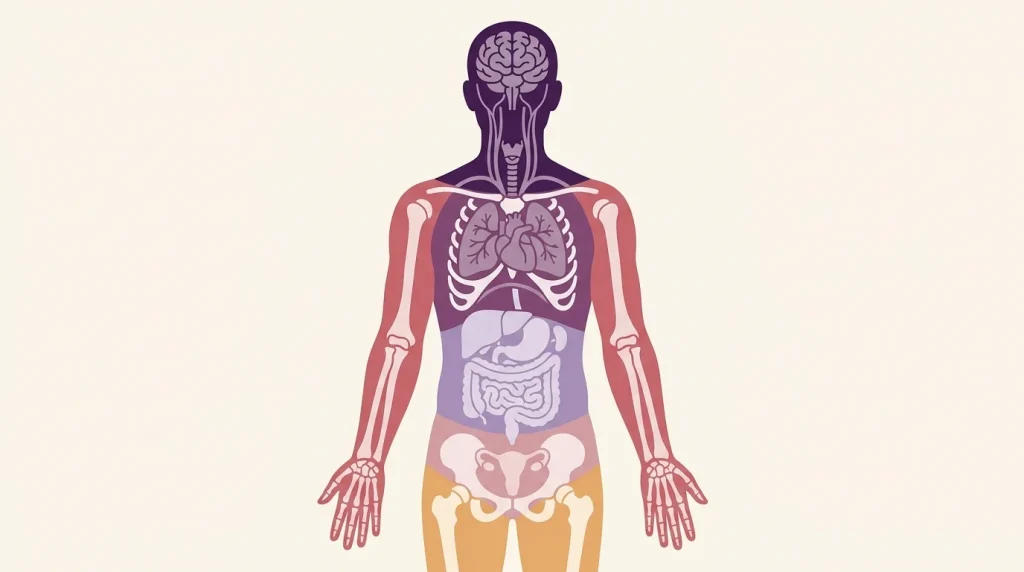
RCEM defines the anatomy curriculum across the standard regional divisions used in the Basic Sciences Curriculum. Candidate reports and revision providers cluster the 60 marks roughly as follows. Treat the per-region question counts as indicative not precise — RCEM does not publish a binding sub-blueprint within anatomy, and the mix varies between diets.
- Upper limb — bones, joints, brachial plexus, nerve and vascular supply, surface anatomy for cannulation and nerve blocks. High volume.
- Lower limb — bones, joints, lumbosacral plexus, femoral and sciatic nerve distribution, vascular anatomy, compartments, surface landmarks. High volume.
- Thorax — ribs, sternum, intercostal anatomy, mediastinum, lungs and bronchial tree, heart chambers and great vessels, diaphragm, surface anatomy for chest drain and pericardiocentesis.
- Abdomen — abdominal wall, peritoneal vs retroperitoneal organs, gut tube blood supply, portal system, urological anatomy, pelvis.
- Head and neck — skull base foramina, facial bones, deep neck spaces, fascia, salivary glands, airway anatomy, ear, nose, throat surface anatomy.
- Central nervous system — brain lobes, ventricles, meninges, blood supply (circle of Willis), spinal cord tracts, dermatomes and myotomes.
- Cranial nerves — all twelve: nuclei, course, foramina, motor and sensory functions, common lesions and their clinical presentation.
Two regions repeatedly produce the highest yield of testable applied questions: upper limb and lower limb. They map directly onto ED presentations — fracture patterns, nerve injuries, compartment syndrome, nerve blocks, dermatomal pain — and they reward revision because the questions reuse the same nerve roots, plexus diagrams, and vascular anatomy across diets. Cranial nerves are the other reliably high-yield cluster, especially lesions producing specific clinical pictures.
How should I weight my revision time across subjects?
The blueprint gives the obvious answer: time spent should approximate marks available. In practice that means anatomy gets at least a third of total revision hours, often more for candidates whose anatomy base is weakest. The table below shows three commonly cited plans (six, four, and three months full-time-equivalent), with anatomy given its proportionate share rather than equal billing with the smaller subjects.
Suggested revision hours by subject and timeframe
| Subject | % of paper | 6-month plan (~300 h) | 4-month plan (~200 h) | 3-month plan (~150 h) | Primary resource |
|---|---|---|---|---|---|
| Anatomy | 33.3% | 100 h | 67 h | 50 h | TeachMeAnatomy + Acland videos + qbank anatomy section |
| Physiology | 33.3% | 100 h | 67 h | 50 h | Ganong / Costanzo + RCEMLearning + qbank |
| Pharmacology | 13.3% | 40 h | 27 h | 20 h | BNF + Rang & Dale skim + qbank |
| Microbiology | 9.4% | 28 h | 19 h | 14 h | Sketchy / Microbiology Made Ridiculously Simple + qbank |
| Evidence-based medicine | 5.6% | 17 h | 11 h | 8 h | CASP + qbank EBM section |
| Pathology | 5.0% | 15 h | 10 h | 8 h | Robbins basic + qbank |
These are scaffolds, not prescriptions. A candidate whose physiology is already strong can shift hours toward anatomy; a candidate with surgical exposure may need less upper-limb time and more cranial-nerve time. The principle that matters is proportionality: anatomy should get a share that reflects 60 marks, not the same share as the 9 pathology marks.
How should I weight my revision time inside anatomy?
Within the anatomy block, divide hours by yield rather than alphabetical order. A practical split for the anatomy-only hours:
- Upper limb — 20% (high yield, dense)
- Lower limb — 20% (high yield, dense)
- Cranial nerves — 15% (high yield, frequently tested by lesion pattern)
- Central nervous system (brain, spinal cord, tracts, dermatomes) — 15%
- Head and neck — 12%
- Thorax — 10%
- Abdomen — 8%
Cranial nerves earn a disproportionate share because they generate a high density of single best answer questions — each of the twelve nerves can produce multiple stems on motor, sensory, foraminal anatomy, and lesion presentation. Treat them as twelve mini-topics, not one.
Which anatomy resources actually earn their place?
The honest answer is no single resource is sufficient. Most successful candidates use one written reference, one visual / video reference, and one question bank with an anatomy section. The shortlist below covers the resources most consistently named in successful candidate reports, with the trade-offs.
Written and reference
- TeachMeAnatomy — free, well-illustrated, clinically anchored. Pros: matches the depth RCEM expects, free at the point of use, fast to navigate, good for revision and quick lookup. Cons: not curriculum-mapped to RCEM specifically; you must impose the blueprint structure yourself.
- Last’s Anatomy (Regional and Applied) — the long-standing UK postgraduate reference. Pros: written for postgraduate exams, applied focus, authoritative. Cons: dense, time-consuming, often deeper than the MRCEM Primary needs.
- Gray’s Anatomy for Students or Snell’s Clinical Anatomy — undergraduate-postgraduate bridge texts. Pros: clear diagrams, clinical correlations. Cons: still pitched broader than the exam.
- Moore’s Clinically Oriented Anatomy — gold-standard regional anatomy textbook. Pros: clinical scenarios match the applied focus. Cons: heavy, expensive, more than you need for a 60-mark paper.
Visual / video
- Acland’s Video Atlas of Human Anatomy — real cadaveric dissection on video, region by region. Pros: builds three-dimensional understanding faster than any text, particularly for upper and lower limb. Cons: subscription, individual videos are long, no built-in question check.
- Frank Netter’s Atlas of Human Anatomy — the classic illustrated atlas. Pros: still the gold-standard visual reference; superb for revising vascular and nerve anatomy. Cons: a reference not a revision tool; you must drive it with a syllabus.
- Kenhub — illustrated tutorials and quizzes online. Pros: structured, gamified, time-efficient. Cons: paywalled for full access.
- 3D anatomy apps (Complete Anatomy, Human Anatomy Atlas) — interactive models. Pros: spatial relationships click in a way 2D images cannot. Cons: subscription, can become a procrastination tool if used unstructured.
Question banks (anatomy section)
- Pastest MRCEM Primary — large bank, mapped to the RCEM blueprint, integrated explanations. Pros: scale, RCEM alignment, the standard against which others are measured. Cons: subscription cost, explanations are uneven in depth.
- MRCEM Success — focused bank with curriculum-mapped anatomy questions and explanations. Pros: clean blueprint mapping, well-priced, candidate reports rate the anatomy explanations highly. Cons: smaller volume than Pastest; less brand recognition.
- BMJ OnExamination / FRCEM/MRCEM banks — quality varies by section. Pros: another sample of question style. Cons: less specifically MRCEM Primary focused than the above two.
A common, defensible combination: TeachMeAnatomy as the spine of revision, Acland or Netter for visual reinforcement on upper limb, lower limb, head and neck, and cranial nerves, and one major question bank — Pastest or MRCEM Success — worked through the anatomy section twice. There is no single “right” stack. There is a wrong one: relying only on a question bank without a structured reference, because the bank teaches the question, not the territory.
Why is the medical-school-recall trap so dangerous?
Anatomy revision feels productive in a way physiology and pharmacology revision often does not. A diagram of the brachial plexus produces immediate recognition. Cranial nerves can be rattled off. The femoral triangle has a familiar mnemonic. The trap is that recognition is not recall, and recall is not application.
The MRCEM Primary anatomy question does not ask you to label the brachial plexus. It gives a clinical vignette — wrist drop after a humeral shaft fracture, paraesthesiae in the median nerve distribution after wrist trauma, weakness of shoulder abduction after a fall — and asks which nerve, which root, which branch. That is three layers removed from “name the diagram”. Each layer hides a place candidates lose marks.
The fix is to test recall under question-bank conditions early. If you can comfortably answer applied anatomy SBAs at the start of revision, you can spend less time on that region. If you cannot, that is the gap, and it is the gap that costs marks on the day.
How does this connect to physiology and the rest of the paper?
Anatomy and physiology together carry two thirds of the paper. They also share territory — autonomic anatomy connects to autonomic physiology; respiratory anatomy connects to lung mechanics; cardiac anatomy connects to the conduction system. Revising them in parallel by region (limb, thorax, abdomen, head and neck, CNS) lets each subject reinforce the other.
The remaining 60 marks — pharmacology, microbiology, EBM, pathology — are not unimportant, but the absolute volume is small enough that a competent pass across all four is achievable in the time the blueprint allows. The danger is the inverse: candidates who over-invest in microbiology lists or EBM formulas to compensate for anatomy weakness rarely recover. The arithmetic does not work.
How do I know my anatomy revision is on track?
Set objective checkpoints, not subjective comfort. Three useful ones:
- Anatomy-only question accuracy. Run timed blocks of 30 anatomy SBAs from a major bank. Below 60% means the region needs another pass. 65–75% is exam-ready. Sustained above 75% means you can shift hours elsewhere.
- Region rotation. Every two weeks, do a 20-question mixed-region anatomy block. If one region collapses (you score < 50% on lower limb when you average 70% overall) that is the region for the next focused session.
- Surface anatomy under pressure. Can you describe the surface landmarks for a chest drain, femoral nerve block, cricothyroidotomy, and lumbar puncture from memory? The applied questions love surface anatomy.
If you cannot meet these checkpoints with four weeks to go, the honest call is to delay the diet. Repeated near-fails on MRCEM Primary cost more — in money, time and morale — than a single deferred sitting.
What is a concrete anatomy-weighted plan for the final eight weeks?
If you are eight weeks out and have not yet started serious anatomy revision, the following pattern fits a 25-hour week:
- Weeks 1–2 (limbs) — Upper limb week, then lower limb week. TeachMeAnatomy region + Acland videos + 40-question bank block per region, plus a parallel physiology topic for cross-reinforcement.
- Weeks 3–4 (head, neck, CNS, cranial nerves) — Head and neck week, then CNS plus cranial nerves week. Cranial nerves benefit from a single mapped table you build yourself: nucleus, foramen, motor function, sensory function, common lesion. Revisit daily for a fortnight.
- Weeks 5–6 (thorax, abdomen, pelvis) — Thorax week, then abdomen and pelvis week. Lower yield than limbs but mark losers if neglected.
- Week 7 (synthesis) — Mixed anatomy question blocks, focused review of weakest two regions, full anatomy mock (60 questions in 60 minutes).
- Week 8 (consolidation) — Two full mock papers under timed conditions. Treat anatomy as the rate-limiting subject — debrief by region, not by question.
Parallel to anatomy, run physiology on the same weekly region cadence and slot the smaller subjects into shorter daily sessions. If you only have four weeks, halve each block and accept that the pass will be tighter.
What is the single most common mistake — and the single best fix?
The mistake: spending equal time on each subject and trusting medical-school anatomy recall.
The fix: front-load anatomy. Start anatomy first, give it the largest single share of your weekly hours, test under question-bank conditions early, and never let two consecutive weeks pass without an anatomy-only timed block. Anatomy rewards consistency more than any other subject in this paper — the material is dense, the recall decays, and the question style is unforgiving of partial knowledge.
Candidates who fail post-mortem this point repeatedly. Candidates who pass front-loaded anatomy and treated it as the largest topic on the paper, not one of six equals. That is the entire article in one sentence.
Authoritative sources
- RCEM Emergency Medicine Curriculum and Basic Sciences Curriculum
- RCEMLearning — MRCEM Primary overview and blueprint
- Royal College of Emergency Medicine (RCEM)
- TeachMeAnatomy
Related on EM Final Exams
- MRCEM vs FRCEM Key Differences and Strategy
- How to Use Question Banks Effectively — Most People Get This Wrong
- The 5 Biggest Mistakes Candidates Make in the FRCEM SBA
- Pattern Recognition vs Knowledge — What Actually Passes You
- How to Revise While Working Full Time in ED
- FRCEM Pass Rates Explained
- What to Do After Every Practice Question — The Step Most Candidates Miss
Ready to build your plan? EMF Premium gives you all 40,000+ questions, 20 mocks and 1,215 OSCE stations from £29/month — or a one-off 3- or 6-month pass.